

Your guide to the heart of Litchfield County:
Discover local stories, hidden gems, and must-know events.

The Heroes on Our Front Line

Heroes

Dr. Eric Salk, a 23-year veteran physician in the Emergency Department at Charlotte Hungerford Hospital, squeezed in a walk with us this spring during the first wave of the COVID-19 crisis. Birds obliviously chirp in the background as he relayed the bottom-line difficulty of the new disease: “It’s actually very frustrating for health care workers, because there is so little we can do, except supportive care.”

Stepping up, day in and day out    

“Once we started seeing the first truly ill, critically ill patients with COVID-19, it was clear that this is a very distinct illness.”

Dr. Eric Salk, a 23-year veteran physician in the Emergency Department at Charlotte Hungerford Hospital, squeezed in a walk with us this spring during the first wave of the COVID-19 crisis. Birds obliviously chirp in the background as he relayed the bottom-line difficulty of the new disease: “It’s actually very frustrating for health care workers, because there is so little we can do, except supportive care.”

Unlike the accounts of overrun floors and borderline chaos in New York City hospitals during that time, Dr. Salk says the situation in Torrington was more of a slog. The volume of emergency room patients was down, but the intensity of those patients’ conditions was markedly up. “It’s scary because, at one end of the spectrum people get very sick. We’re constantly having to make decisions about the level of precautions to use, trying to be judicious about the use of personal protective equipment (PPE)…every machine has to be wiped down between scans.”

On that all-important point of personal protective equipment, Charlotte Hungerford was fortunate. Officials say its connection to the Hartford HealthCare system afforded it access to a stockpile of PPE originally acquired for the Ebola outbreak. Having that PPE, however, hasn’t made for smooth sailing.

“It’s physically tiring…when you’re in full masks and face shields, and full gowns and gloves,” adds Teresa Fuller, VP of Patient CareServices at Charlotte Hungerford,  “You’re tired, you’re hot…it’s more difficult to care for patients.”

On top of it all, her staff can’t leave the crushing sadness or new-level stress of their jobs at work. “It’s extra challenging because of all the worry and because life is not really the same when you go home. You’re not able to do the things that you were once able to.” 

eric salk
Dr. Eric Salk

Case in point, Dr. Salk. A friend let him borrow a guest house so that he wouldn’t run the risk of infecting his family. When he does visit home, he is sterilized to the hilt, and masked. His free time is spent consuming the latest treatment information, making it “pretty nerve-wracking, but at the same time fascinating.”

While he does his part, Dr. Salk is quick to turn the mirror and acknowledge the entire community’s efforts, “The self-isolating, and self-distancing, it IS effective. It may not seem like it, but everybody’s doing their part. Our community here in Torrington and the surrounding towns has been phenomenal. The various restaurants in our area have delivered food every single day, for every single meal, to our staff.” 

“The donations from the community have been extraordinary,” added Brian Mattiello, VP for Strategy and Community Development at Charlotte Hungerford. Mattiello took in hundreds of homemade 3-D printer face shields, gowns, handmade cloth masks, and thousands of surgical masks from schools, vendors, and private citizens. He also witnessed the steady stream of well-wishes written to frontline workers. “Born and raised here. I’ve known this place all my life and have fallen in love with it all over again. It’s a pretty special community.“

Written by Brandee Coleman Gilmore


Covid-19: Everything Changes Except The Farm

Smyrski Farm Lead

Covid-19 has taught me something I’ve been trying to learn my entire adult life: We can grow, move on, and experience “new pastures.” We can fight for change but to do so, we must not forget to keep intact the roots of all the freedoms we enjoy, which are often the smaller ones we tend to take for granted.

By Kim Wheeler Valzania of New Milford, CT

When my sister Keri was a little girl, she bounced like a spring from her bed on the first day of summer vacation, and swiftly pedaled her banana-seat Schwinn “chopper” down Merryall Road toward the Smyrski’s Farm. For Keri and I, the 1970’s were a magical time when encouraged outdoor activity melded seamlessly with limited parental supervision. “The Farm” (as we’ve always called it), was literally right around the corner, less than a mile away from our little white, shoe-box, ranch house on Mt. Tom Road. My industrious sister was on a mission. At age seven, she was set on getting herself a “summer job” so she wouldn’t be bored all day. 

The Smyrski Farm, known today as Mayapple Hill Farm was owned and operated by four of the seven Smyrski siblings: Lucy, Sophie, John, and Mary. Their large, “Italianate Victorian” style farmhouse occupied one side of the quiet country road, while directly opposite sat their beautiful barns, dairy buildings, open pastures, and grazing fields.  

smyrski house

After hustling her way there, Keri chucked her bike on the lawn, and earnestly knocked on the front door. Mid-breakfast, Lucy answered. Timidly, my sister asked, “Can I work here?” Keri recalls that Lucy stopped chewing and squinted at her for a moment before smiling kindly. “You don’t have to pay me,” she pleaded. “I just want to work here and help you with farm stuff, and be around the animals as much as possible. Would that be okay?”

I can only imagine what Lucy Smyrski was thinking that morning. On her well worn stone slab doorstep stood a tan, shy, wide-eyed snip of a girl with dirty knees and a requisite Dorothy Hamill bowl haircut who was looking up at her with a mixture of hope and resolve, though more importantly, without a parent in tow telling her what to say. How could Lucy Smyrski say no? Keri wanted to be “allowed” to work all day, and my goodness, she was willing to do it for free!

I quickly latched on to the coattails of my sister’s idea, but truth be told, I was more of a farm work “dabbler.” I loved hanging out at the farm, but did so when it suited me, which was when a calf was about to be born, or something equally fun was happening. I can’t claim that I was as dedicated as she was to completing the jobs we were given, but I hauled my fair share of fieldstone from the jagged meadows, and most certainly cleaned out a few dirty barns and pens. I helped with the milking too, and especially loved the “retired” dairy cows that no longer produced, but were still “part of the herd.” These “older ladies” were kept in a separate corral and given sweet names like Evelyn (better known as “E.C.”) and Constance. Like my sister, I just loved being there. 

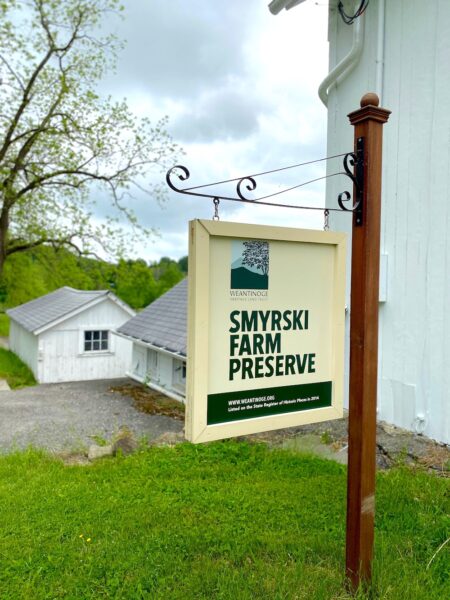
perserve sign

Growing up in the Merryall section of New Milford, my family folklore includes this story of how my seven year old younger sister landed her first job and let me tag along for the ride. It was a “job” laden with lovely, enduring childhood memories. Recently, we spoke about our summers helping the Smyrski’s, with Keri adamantly declaring, “it was one of the best things I ever experienced because it taught me a lot about real work ethic, death, birth, people, animals, industry, and of course so many of the lost pleasures that don’t involve a screen of any kind.” 

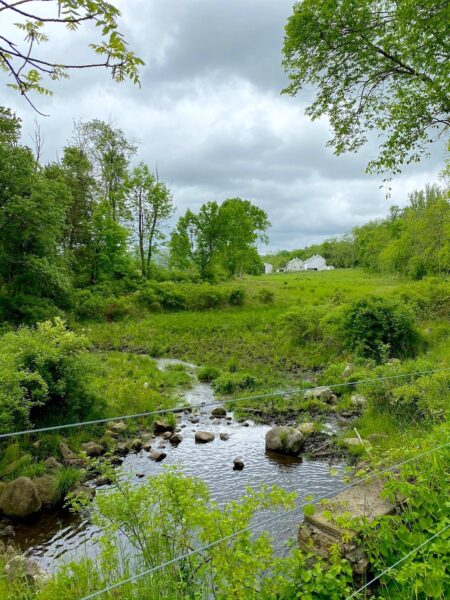
smyrski land

She clocked countless hours there. On rainy days she would curl up in the loft of the big red barn, (erected in 1763), and read while inquisitive, but somewhat feral cats watched for a bit, eventually making their way closer. The barn was Keri’s favorite place on the farm, and she often remarks that her memories of summers spent helping the Smyrski siblings are still clear as a bell.

Exhausting, soul-feeding days spent really working (yet enjoying every minute of it from sun up to sun down) is not something a kid ever forgets. 

I believe Covid-19 has most of us forgetting the perennial, cyclical nature of life. One thing I keep hearing is “this too shall pass,” and I believe it. Right now, though, it’s challenging to think about anything other than getting through this pandemic and back to “normal.” I think we might all agree that normal will look a lot different when this is truly over. Covid-19 has taught me something I’ve been trying to learn my entire adult life: We can grow, move on, and experience “new pastures.” We can fight for change but to do so, we must not forget to keep intact the roots of all the freedoms we enjoy, which are often the smaller ones we tend to take for granted. To simply be free from worry, or free to roam are no small things. Aside from resilience, I’m learning to step back once again. It’s not that I appreciate things more now, it’s that I appreciate things, period. 

Photos in post by author. 


Democracy in Color

Black Lives Matter

As protests over racial injustice mobilize the country, Conversations On the Green is holding a necessary and difficult conversation about race. On June 28 at 3 pm, “Democracy In Color” a FREE livestream discussion will take place with three nationally known civil rights activists.

As protests over racial injustice mobilize the country, Conversations On the Green is moderating a necessary and difficult conversation about race. On June 28 at 3 pm, “Democracy In Color” a FREE livestream discussion will take place with three nationally known civil rights activists.
In the wake of the barbaric killing of George Floyd, as America smoldered over another case of unequal justice, Michelle Obama channeled the anguish and the anger of the moment when she said “I’m exhausted by the heartbreak that never seems to stop.”

Continue reading “Democracy in Color”

Taking the Plunge: More Than Just a Pool House

Haver pool house

Roxbury architects Charles Haver and Stewart Skolnick received the go-ahead in September 2018 to design a swimming pool, pool house, and gardens on a 70-acre gentleman’s farm in Washington.

By Douglas P. Clement

Roxbury architects Charles Haver and Stewart Skolnick received the go-ahead in September 2018 to design a swimming pool, pool house, and gardens on a 70-acre gentleman’s farm in Washington owned by a dream client who previously had them renovate a barn into an entertainment building, design a new main house, renovate a guest house and a stable, and oversee the property’s landscaping. “The client was really terrific. They gave us complete artistic license,” Haver says. There was just one caveat. This new summer retreat had to be move-in ready by Memorial Day 2019, which meant working through the winter and compressing the normal timeframe by nearly four months. 

The pressure was on, which meant the veteran architects and their team of professionals needed to innovate. Seth Churchill of Churchill Building Company suggested creating a tent to protect Drakeley Pool Company’s pool construction site from weather conditions, and landscape architect Wesley Stout performed “planting magic” in very short order as the clock ticked down. In the end, Haver jokes, “The coffee table arrived at ten am and the client arrived at 11 am.”

pool house
Robert Benson

Hidden within the anecdote is the reason luxury properties broker Maria Taylor of Klemm Real Estate calls Haver & Skolnick Architects-designed properties “eminent masterpieces” and testimonials from clients universally praise the architects’ refined aesthetic, professionalism, and attention to detail. 

The Washington pool house project may have come together quickly, but the pace of the project merely inspired especially enlightened design, giving the hilltop landscape with views of Mt. Tom a year-round bijoux that Skolnick calls “the last piece of the puzzle” for the property. 

“The other buildings are very traditional,” he says. “We wanted this building to feel a little bit different. We wanted to make it a contemporary piece of architecture.” Though the pool house riffs on a traditional saltbox design, it embodies modernism through both a defining design element and the curation of materials.

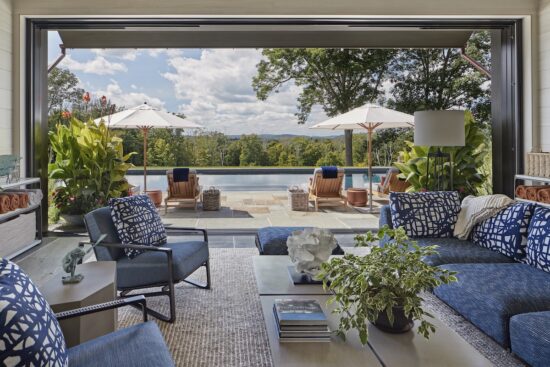
“We designed the building itself almost to be an open air porch in the summer,” Haver says, noting the fully retractable glass panels facing the pool that blur the line between interior and exterior, as the bluestone paving of the pool terrace extends into the pool house. “You really feel you’re part of the whole environment,” says Haver. 

pool house
Robert Benson

“Everyone views what modern means in a different manor,” Skolnick says. “One of the things Charles and I think makes a modern building is getting the palette of materials down to just a few elements. In this case, the silver weathered siding structure, punctuated by contemporary copper overhangs and lanterns, features just three interior materials, bluestone slabs, whitewashed pine board, and oil-rubbed bronze. 

If the form delights the eye, then the function nourishes the family’s soul. The pool house features a gym, a pantry, and carefully incorporated storage areas, as well as a double-sided central fireplace giving the building four-season appeal. “It’s a great place to sit in a snowstorm with the wall of glass and wonderful view,” Haver says.

The pool itself features a submerged spa and a series of gradual entry platforms, where guests can lounge. 

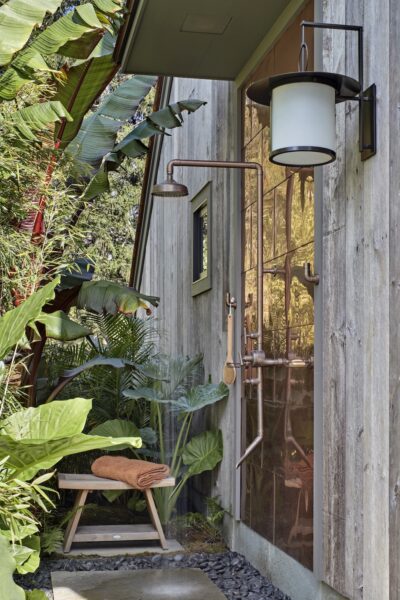
“When they come up from the city, they want to spend time together even if they’re doing different activities,” Skolnick says of the clients. “The whole design is meant to inspire social interaction.” Everything and everyone is tied together by the view in a resort-like atmosphere with lush tropical plantings. The pool terrace, for example, is framed with tall grasses, and the copper outdoor shower is surrounded by banana plants. 

outdoor shower
Robert Benson

“This client could choose to spend their summers anywhere. We tried to create a very unique environment, the sense they were getting away from the main house,” Skolnick says. In January, the architects received word the pool house project had won a 2020 Bulfinch Award in the Small Project/Folly category from the Massachusetts-based Institute of Classical Architecture & Art, devoted to advancing the classical tradition in architecture, urbanism, and allied arts.

Covid-19: Fragment from The Salt Diaries

covid 19 essay

It seems that God is going to deduct this entire year out of our paychecks. Everything these days —the past, the present and the future—is at a standstill. We are living inside a horizontal hourglass. Within this parenthesis, I feel wealthy:

This is the ninth of an essay series that will be published as long as social distancing is necessary. All pieces are written by Litchfield County residents. If you are interested in submitting an essay for consideration please email us at info@litchfieldmagazine.com.

By Florin Firimita of Winchester, CT

It seems that God is going to deduct this entire year out of our paychecks. Everything these daysthe past, the present and the futureis at a standstill. We are living inside a horizontal hourglass. Within this parenthesis, I feel wealthy: I own everything I set my eyes on: the woods and trails of the White Memorial; the entire Topsmead State Forest; the thousands of daffodils at Laurel Ridge Farm. I am also the proud owner of several invisible islands, an archipelago of sorts. I have been aware of the existence of some of them before: Hunger, Loneliness, Confusion, Fear, Heartbreak. Some are new: Anxiety, Doubt, Resilience, Time. There is time but I’m already tired of time. There are people, but they’re not real. Each face on our endless Zoom meetings becomes an island, each island becomes a mask. Some of us are Tiktoking our way through private tunnels of fear. Some of us are spending hours on yoga mats. Life continues and so does the slaughter. This is how it’s supposed to be on planets where you can’t leave your space station without any armor and an oxygen tank attached to your back. In the past several months we have become deep sea divers in the ocean of Doubt and Uncertainty.

From the deceiving safety of our Litchfield Hills, the world’s collective pain seems far away. I think about how every milestone that we have been reaching these days is tragic: more Americans died because of this virus than during the Vietnam war; there are now 1 million confirmed cases in the country. Yet, the numbers are here, they are real and they change by the hour: 1,065 confirmed cases and 95 deaths in our county. I think about the ER physician in Manhattan, who committed suicide. It’s not that complicated to feel guilty while getting ready to enter a grocery store the way you enter a combat zone and think that you could die in a few days because you touched a can of beans or opened your mail. I am ashamed of being afraid. During the good old Cold War days I lived In Romania. During that country’s violent revolution, I became good at dodging bullets. There was a physicality to the sound of a bullet coming at you, entering the trunk of a tree or the body of an anti-government protester. As an American I am dodging fog bullets. Trust me; the fog ones are as real as the metal ones. 

Florin Firimita Aix en Provence France 2009
Art by Florin Firimita

Some believe that one cannot die at the beach on a sunny day. Some believe that you could point a gun at a virus as if performing some sort of exorcism. I think it was Camus who said that all deaths are absurd, but I think that all lives are meaningful. The past and the future are equally fictitious. One gets transformed by memory, the other by hope. The only reality I am afraid, is that of Today. I have friends who are physicians. We shouldn’t call them “heroes” now more than six months ago. They were heroes back then, when they were showing up for work every day and when we took them for granted. We have been taking a lot of things and a lot of people for granted. I post pictures of my cat on Facebook while someone commits suicide in Manhattan. What’s my excuse? To remove the halo of fear from my days? To keep my illusionary band marching on? 

From my European perspective – industriousness is primarily an American thing. Nothing wrong with it. It made us who we are. All of a sudden, we are painting our homes, attending virtual concerts, moving dirt around, building additions to our homes. We are super busy, all the time, every time, day and night, as if some sort of moral judgement awaits us at the end of each day ready to strike. I have no major projects to work on. No retaining walls to build, no paint jobs, no office remodeling projects, nothing to prove. I have already written a novel, so what should I write now? The restless ants working inside my brain are spilling into my sink and into the pages of my journal, feeding on the scattered leftovers of my past lives.

“I hate public displays of affection,” a woman I once loved used to tell me. It was embarrassing to be seen in public holding hands, to read Neruda or Leonard Cohen in the burned shadow of the Notre Dame cathedral, or to say I love you. Some of us have been practicing social distancing well before it became the law. My sink full of dishes disagrees that appearances must be kept at all cost. 

And even if technology has been making us more connected than ever, we are still unable to live with ourselves. After the screens of our devices turn dark, after we run out of movies, after the music stops, reality kicks in like a long-lasting toothache. Only a few of our children know how to reach for their inner selves. They don’t know that aloneness is not loneliness; that aloneness is balance. There is an untranslatable Spanish word: “recogimiento” that is often mentioned when it comes to Borges. The blind poet is the ultimate embodiment of this concept. It has nothing to do with creating a prison within yourself. Living in “recogimiento” is about discovering your inner resources and opening the pantry of your soul, finding that even in the darkest hours, you have enough resources. I am not sure how one gets there, but if you do, your fears will stop translating into being busy all the time. Being busy is a type of avoiding our reflections in the vast army of mirrors surrounding us

This will be transformative for most of us. Yet, strangely, the Plague has no power over me except for making me look a little closer at myself. We, Americans, are a bit guilty of blindness, the type that comes with a sense of entitlement. Maybe the American dream needs to be power washed by a tragedy of this magnitude in order for us to wake up. Would it hurt to hold hands again? To pay a little more attention? A little bit more than during the last world war, when we kept dancing to Artie Shaw while the ovens of Auschwitz were working nonstop. A little bit more than after 9/11, when we realized that we were not a happy island anymore. Maybe that’s a type of contribution we could all make while allowing our selves to be filtered through this tragedy. From our self-centered insularity of the beautiful area of Connecticut we live in, maybe it’s time to start learning the names of our neighbors, to have real conversations and meaningful relationships, to do more for each other, to hold hands, to say I love you, to realize that each of us are insanely wealthy just because we are able to open our eyes every morning. 


Rumsey Hall School – 120 Years and Still Being Discovered

Rumsey Hall School

Prior to the Covid-19 pandemic, the 120-year-old Rumsey Hall School existed humbly as a premiere junior boarding and day school tucked away in the Shepaug Valley of Washington—some knew of it, some didn’t. 

No matter the season, Rumsey Hall is a special place to be.

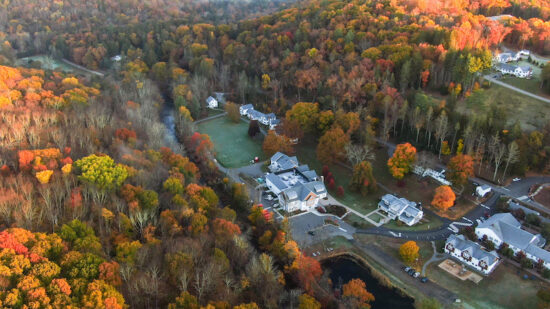
Down on the banks of the Bantam River and across a one-lane bridge in Litchfield County, lies the bucolic campus of Rumsey Hall School––an independent, co-ed private school rooted in a family atmosphere, and anchored by community and traditions. In the fall, a crown of fiery trees surround the fields and recreational ponds. In the winter the pond transitions into an outdoor skating rink, and in the spring, white flowering pear trees thread through the heart of the campus, outlining School Street.

 Rumsey Hall School

Prior to the Covid-19 pandemic, the 120-year-old school existed humbly as a premiere junior boarding and day school tucked away in the Shepaug Valley of Washington—some knew of it, some didn’t.  Now, as we navigate a new normal, some city-based weekenders are discovering it for the first time, and perhaps, for the long haul. Maybe it would be worth enrolling their kids into a local school and continue to telecommute as they’ve been doing since March?

“It’s an investment, to be sure, but a sound one,” says Rumsey’s Director of Advancement, Tina Couch ’94.  “We have the ability to tailor our educational program to complement how kids learn individually in such a way the public schools in the city can’t because their resources are more limited.”

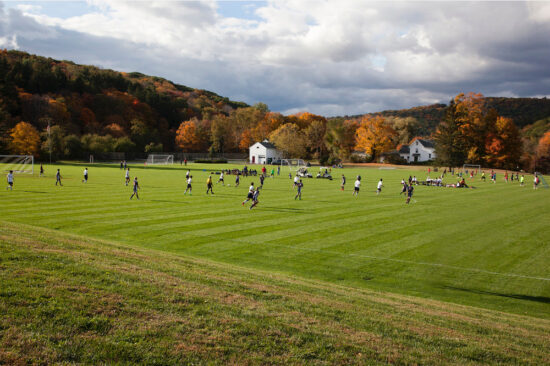
Rumsey Hall’s small class sizes offer individualized attention and are only rivaled by its unfettered access to nature and a team of faculty and staff dedicated to educating the whole child in what the school has dubbed “a Tradition of Effort, Family & Community.”  With robust sports offerings, arts and language enrichment opportunities, and community service projects, new students quickly find a niche.

lower school

Just take it from the Headmaster, Matthew Hoeniger ’81, who back in the day, reluctantly joined Rumsey’s day community and bet his father he’d want to leave within two weeks. However, after the first term,  Mr. Hoeniger asked if he could start boarding. “You’re in an environment, in a community, where the adults—the faculty and staff and administration—enjoy, love working with middle school-aged students.” To him, Rumsey isn’t just a school. It is a place where he feels at home.

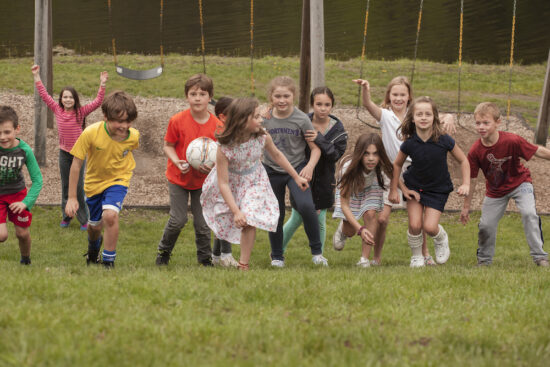
Rumsey offers that same welcoming feeling and community to 300+ students who attend the school’s Lower (K-5th) and Upper (6th-9th) Schools. Half the Upper School students board, coming from 15 states and 12 countries.

“Living at an international boarding school helps students realize how large the world is while also discovering how much they have in common with other kids their age,” says Frankie Winter, the School’s Director of Communications.

Rumsey kids

Winter adds, “Our goal is to set students up to go out into the world with solid interpersonal skills and enduring values—and I don’t know if that’s unique to us—but I believe we do it very well.”

Director of Admission, Ben Tuff, indicates that many of Rumsey Hall’s current families would agree. “At our school everything is in one place: education, athletics, friendships, and activities. Rumsey exemplifies the idea of what a true community is all about.”

If you would like to learn more about Rumsey Hall School, please contact Director of Admission, Ben Tuff via email at btuff@rumseyhall.org or via phone at (678) 296-0982.

rumsey hall field

Rumsey Hall School
201 Romford Road, Washington, CT

SPONSORED POST
Written by Brandee Coleman Gilmore

Secrets to Tell

Loch Johnson

When a covert agent surfaces in an exotic location in spy movies, trouble isn’t far behind. So when Loch Johnson, a leading expert on U.S. intelligence organizations, moved from his longtime home in Athens, Ga., to Salisbury last June, it meant something.

U.S. Intelligence expert lands in Salisbury

By Douglas P. Clement

When a covert agent surfaces in an exotic location in spy movies, trouble isn’t far behind. So when Loch Johnson, a leading expert on U.S. intelligence organizations, moved from his longtime home in Athens, Ga., to Salisbury last June, it meant something.

Over lattes and proper English scones at The White Hart, Johnson anticipates the “why are you here” question. “Grandchildren,” he answers simply. It might be brilliant deep cover—except the story checks out. Johnson’s daughter Kristin Swati, once an analyst for Goldman Sachs, founded the online children’s clothing store Fawn Shoppe in 2010 and lives with her family in Copake, N.Y.

A grandchild attends Indian Mountain School, where Johnson was headed that day to teach first-graders chess, not the topic he lectures on at venues like Georgetown, Yale and West Point—and these days also at Hotchkiss School and Salisbury Public Library.

The Regents Professor Emeritus of Public and International Affairs at the University of Georgia, Johnson is focusing on writing after a four-decade career in academia and holding high level U.S. government positions that afforded him an insider’s view of U.S. intelligence operations. Among his many notable roles, Johnson served as special assistant to the chairman of the Senate Select Committee on Intelligence (1975-76), which investigated intelligence agency abuses, and as special assistant to Chairman Les Aspin of the Aspin-Brown Commission on the Roles and Missions of Intelligence (1995-96).

Johnson’s latest book is “Spy Watching, Intelligence Accountability in the United States” (Oxford University Press), offering an authoritative overview of intelligence agencies and Congressional oversight. His most influential contribution as a book editor is “Intelligence: The Secret World of Spies, An Anthology,” which is so widely used as a textbook for intelligence studies courses it has made The Washington Post’s best-seller list.

“I find my writing time has doubled,” says Johnson of his emeritus status and move to Salisbury. His work in progress about covert actions is entitled “The Third Option.” In supercharged political situations, diplomacy is the first option, going to war second. As a third option, Johnson says, “You try and change the world using hidden forms of intervention, which might ultimately include sabotage and even assassinations.”

It’s a topic with high audience appeal judging by the questions Johnson gets at speaking events. Older guests want to know if there’s a deep state and exactly what the CIA does, and students ask how to get a job at the CIA. “A truly sophisticated audience asks if we really need to conduct these activities,” says Johnson, who generally finds value in the covert operations but thinks judges the scope of intelligence agencies to be too narrow.

“They’re riveted in on military threats,” Johnson says, and should expand the focus to issues like the environment and pandemics. “You go to a security meeting and try to take about ice floes and people snicker. What if you wanted to hide a submarine under an ice floe? There are connections. How long will the ice floe be there? The bottom line is I think the CIA needs to expand its focus.”

Johnson is harsher when it comes to President Donald J. Trump, writing in the January issue of the journal Intelligence and National Security, “No president has engaged in political warfare against the intelligence agencies of the United Sates to the extent Donald J. Trump has, with his three-year-long attack against them.” Johnson, formerly senior editor of the journal, suggests President Trump “could have taken the role of intelligence in national security affairs more seriously, as a lamplight helping the United States to see more clearly the pathway forward in world affairs.”



Covid-19: This is the Way

covid19 Emily Ohara

But now, as a Political Science and English double major, I feel like I need to find a way to explain this bubble we have had to slowly construct around ourselves. I write my way through these enclosures because it’s a quaint little form of escapism. At the same time, I wanted to do it through structure: through T.S. Eliot’s “The Hollow Men.”

This is the eighth of an essay series that will be published as long as social distancing is necessary. All pieces are written by Litchfield County residents. If you are interested in submitting an essay for consideration please email us at info@litchfieldmagazine.com.

By Emily O’Hara of Northfield

I do all of my thinking in my kitchen now. I occupy the lower right corner of my kitchen table and type for hours. Conference calls lead to conference calls lead to dinner and happy hour. These bleed into a few essays here, a Zoom meeting there. I’ll tutor for a few nights a week. I am one of the faces of the Class of 2020—a soon-to-be college graduate. I’m finishing the last of eight semesters, seven of which completed, six hours a week tutoring, five classes per semester, four years of schooling, three internships in summers, two majors, one degree. Four years later, I think I might be more confused than when I started. But now, as a Political Science and English double major, I feel like I need to find a way to explain this bubble we have had to slowly construct around ourselves. I write my way through these enclosures because it’s a quaint little form of escapism. At the same time, I wanted to do it through structure: through T.S. Eliot’s “The Hollow Men.” We read it in my senior year AP Literature and Composition course. Litchfield High School. Ms. Ferrari. My fellow Litchfield graduates (and soon-to-be graduates) know this too well. 

You may know “The Hollow Men,” too. It ends with: 

This is the way the world ends
Not with a bang but with a whimper. 

Grim and ghastly, this one section of the poem is representative of a larger narrative of truly hollow men, implicating genocide, imperialism, colonialism. These are things we perpetuate today under different names. While I could write books on this—and truly, I’ve studied multiple texts a semester on the topics, writing essays of notable length—I want to consider those final two lines of Eliot’s work: This is the way the world ends. Not with a bang but with a whimper. 

This is not the way the world ends. This is the way we see holes in a fabric that has been pricked by the heels of those who do not care where they’re stepping. This is the way we open our first aid kit and find it empty. This is the spotlight, not on a star, not a singer, but instead shining on the nothingness that Samuel Beckett would create. This is the nothingness we would be obligated to stare at in a theatre for two hours, a nothingness representing months spent in fear. A darkened stage with a blinding light of oblivion. This is not the way the world ends. 

This is not the way the world ends. This is the way the shortcomings come and the outgoings go. This is the heartbeat, slowing, slowing. This is that steady rhythm, an electronic rhythm, that nobody wants to hear. This is the thought experiment that came to life and turned into a nightmare. This is the pain of loss coupled with the pain of isolation. This is a should have. Could have. Would have. This is not the way the world ends. 

Note. 

Here is the way the world ends: not with a bang, but with a whimper that echoes from mouth to mouth around the world. Not with a bang, but with the implication of a culture with a disease. Not with a bang, but with antipathy. Not with a bang, but with the “I” over the “we.” Not with a bang, but with a silence that threatens to suffocate us if we do not feel like humanity again. Not with a bang, not with a whimper, but with a silence that stems from acceptance with the way things always were, and the way they never will be again. This is the way the world ends, and it must be stopped. It must be answered and answered with a resounding response that says, “No,” emphatically, confidently, with the force of all of us. 

This thing, though, this thing is not the way the world ends. This is not the way the world ends. We are in a pandemic, in which people are not endemic of disease. A fever, a cough, the swelling, the filling: these are endemic. This is the way we listen, really listen. To the body, to heart, to mind, to eyes, to hands, to lips, to face. Listen to the things we can see and hear right now, not touch. This is the way we blossom. This is the way we rethink the way we thank (stay home, please). This is the way my mom learns to color her hair (less than an hour!) and I learn to sew in the dead of night at my childhood desk (more than an hour!). This is the way we question ourselves, our lives, our beliefs. I am. Am I? This is the way we build bridges, but carefully. They need not be beautiful bridges like the apartments that are crumbling even though they cost more than a student’s income. They need not stand tall and perfect and hollow like the facades that create shadows over (empty) Central Park. They can have holes and faults and things wrong because things wrong don’t mean failure; they show there is something to improve. This is the way we build a bridge of olive branches from you to me and the things we do not understand. 

This is the way we build a bridge of olive branches. This is the way we build a bridge. This is the way we build. This is the way we—This is the way. 

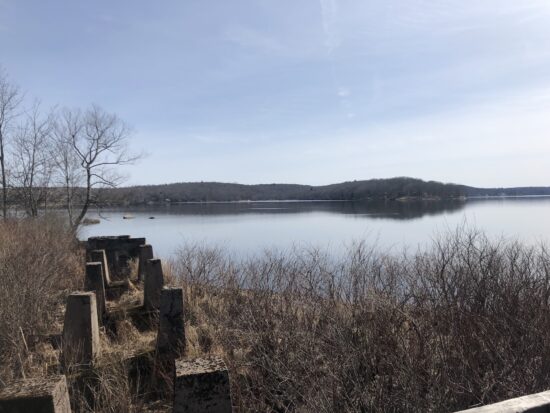
bantam lake


10 Minutes with Nicole Tongue

Nicole Tongue

Nicole Tongue has spent the last 30 years working in the worlds of ballet, opera, and theater as a performer, choreographer, and director but has recently switched gears into rock and roll as producer of The Heroin Diaries.

Nicole Tongue has spent the last 30 years working in the worlds of ballet, opera, and theater as a performer, choreographer, and director. Now with her husband, Allen Kovac—longtime Motley Crue manager and CEO of Eleven Seven Music Group—Tongue has switched gears into rock and roll as a producer of The Heroin Diaries; a musical about Motley Crue musician Nikki Sixx’s autobiography. Tongue, a Roxbury resident, shares how she stepped out of the box to produce this important show.

Where did you grow up and when did you begin performing?

I grew up in the South of England in a tiny little village called Cerne Abbas in Dorset. We lived in a 17th century thatched cottage. My earliest memories of me dancing was when I was four around the kitchen with my mother. By 13, I was accepted into The Royal Ballet School which then took me into a career as a professional ballerina and choreographer.

How did you end up in Litchfield County?

11 years ago, a trip to Jacobs Pillow prompted a look into Litchfield County thanks to my mother’s recommendation that we get in touch with a family friend who lived in Roxbury. We moved full time in 2017 so our son could start at Washington Montessori School.

How did you become involved in producing a musical about The Heroin Diaries?

In 2011 my husband Allen Kovac told me he had the idea of turning one of his client’s stories into a musical and asked if I would be interested in being the creative producer. “I don’t do musicals,” he said, “This is in your world,” and I replied, “I don’t do rock, and I’ve never produced.” But I was happy to take a look. 

Why was this project important to you? 

I was struck by the miracle of Nikki’s survival, how compelling and important his story was, and how moving and captivating the music was. If someone from the classical world could connect with this, then anyone could.

What is The Heroin Diaries about?

The Heroin Diaries tells the story of a determined young boy, desperate to get out of Jerome, Idaho, his dysfunctional family; parents who abandoned him, and his making something of his life. Nikki has a vision for a band, moves to LA, teaches himself how to play bass, and puts together a motley crew of musicians. By 1986 he is at the height of fame as well as the height of his addictions. Heroin has become the one thing in his life that fills his hole of pain, unconditionally there for him, but robbing him of the thing he wants most; love and connection.

Why is this musical so important to tell? 

Sadly the opioid crisis is now an epidemic, 130 people a day are dying from opioids, more than from traffic accidents, and 21 million Americans are affected by substance use disorder. 

The mission of this musical is to de-stigmatize opioid addiction, raise awareness, and save lives.

 When can we see the show? 

Stay tuned this coming November for shows on the East Coast. 

And, bringing it back to Litchfield County, what do you love about living here?

I love the four seasons here, spending time in nature with my friends and family is food for my soul. Working with ASAP for their 20th anniversary last year showed me how far the community extends, and the extraordinary talent of the residents. I feel blessed to raise our son here and be a part of such a thriving, creative, and supportive community. 


Rooms with a View

harley cover

“We fell in love with the area,” recalls Harley. “But since we had just bought an apartment in New York we had no intention of taking on another project.” But they did. After looking at a handful of properties, Hartley settled on a cottage on Lake Waramaug.

A Renovated 19th Century Cottage on Lake Waramaug Stays True to its Roots

By Joseph Montebello

The 1880s fisherman’s shack (or poker shack as it was also known) was in dire need of some TLC and an owner with a keen eye to its history and its potential. Enter Sheila Harley. Eight years ago, having just returned from London where she, her husband, and their three children had been living for twelve years, the family was invited to visit friends in Litchfield County. 

“We fell in love with the area,” recalls Harley. “But since we had just bought an apartment in New York we had no intention of taking on another project.” But they did. After looking at a handful of properties, Hartley settled on a cottage on the lake. While it didn’t meet all their criteria by any means, it was only doors away from their friends, so the children could all play together, and it had the most spectacular view. 

“The house had apparently been a wedding gift to someone in a neighbor’s family way back when,” says Harley. “The theory is that the men would come down to play cards and drink during prohibition. It had no insulation and was truly inhabitable only in the summer. After a discussion with our contractor John Dinneen we wound up taking the house down to its studs, adding proper insulation, and bringing everything up to code.”

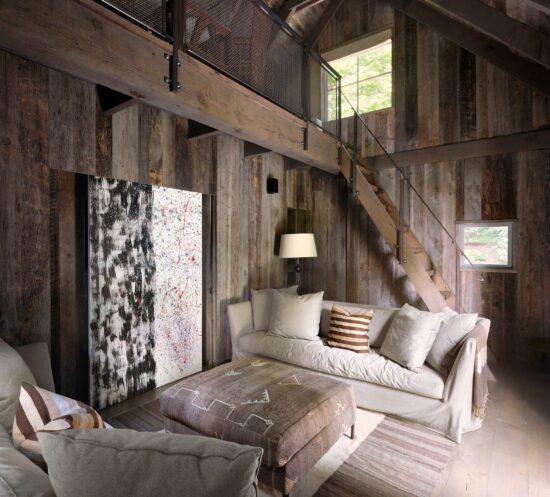
interior design

The old red barn on the property was built in the same time frame, but it was so compromised that it was torn down and rebuilt on the original foundation. The interior is made of salvaged barn wood. The owners retained the original footprint but pushed out on one side to create another bedroom, bringing the size of the house to 2500 square feet. They also added an open front porch. 

Harley, a family therapist, had a previous career as an interior designer and so creating a comfortable and stylish interior was easy for her. She did, however, need some guidance on structural issues. 

“It was definitely a collaboration,” she explains. “I looked to Suzanne Greishel, an architect I knew from my first career. We brainstormed about how to honor the footprint and history of the cottage while incorporating modern elements such as the zinc roof, monolithic stone fireplace, zinc shelving, and gray oak sawed doors and flooring. Every decision around the architecture and interiors took into consideration the lake and how we could orient the space toward the view.”

To furnish the house, Harley made use of pieces she already had and filled in with purchases from local merchants. “I buy things I love, even if I don’t have a place for them at that moment; I know they will work out someday. I decided I would buy local for anything I needed and got my first piece of furniture for the house at Pergola in New Preston. Privet House, Plain Goods, J. Seitz, Michael Trapp, KMR Arts, and George Home provided the inspiration with their beautifully curated collections of objects and furniture. They all contributed by providing a wonderful point of view and ability to help edit and redefine along the way. It’s truly a unique shopping experience for me.”
harley house

To create the vision for the exterior Harley consulted with landscape designer Liz Kay, of Liz Kay Finial Design, who focused on how to integrate the house and the barn with the front terrace and the garden in back of the house, again making the most of the lake view. Materials were limited to stone from the area, pea stone, boxwoods, and plantings of green and white. The goal was to create a calm backdrop with varied seating areas to enjoy the view at different times of the day. And it all works seamlessly. 

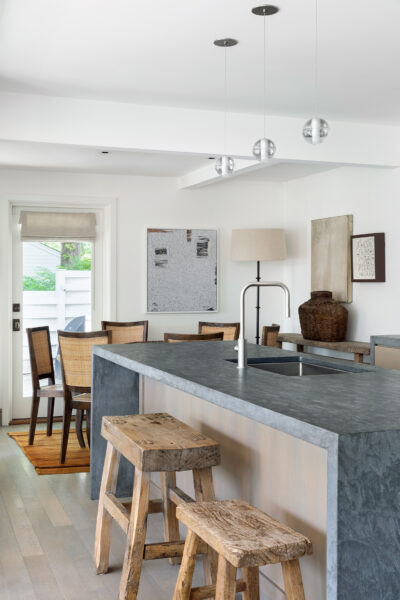
harley kitchen

The property is just shy of one acre, although it appears to be much larger. “We have the advantage of backing on to our neighbor who gifted 100 acres to the land trust,” Harley says. “So behind us are completely open woods with streams. I feel like the custodian of someone else’s land.”

“We spend as much time as we can here, our kids learned to water ski on the lake and we love grilling outdoors, shopping at the farmers market, and having friends over for an impromptu dinner—such a different experience from our city life.” Nature provided the scenery and Harley created a perfect Shangri-La.


Current Issue
May / June 2026
The Garden Issue
Subscribe Now
.
  • STAY IN THE KNOW

    Your weekly guide to can't-miss events, hidden gems, and local favorites in Litchfield County. Sign up now for curated things to do, eat, and explore—delivered every week. It’s free. It’s local. It’s essential.

  • Karen Raines Davis