
Your guide to the heart of Litchfield County:
Discover local stories, hidden gems, and must-know events.

Two Wheels at a Time

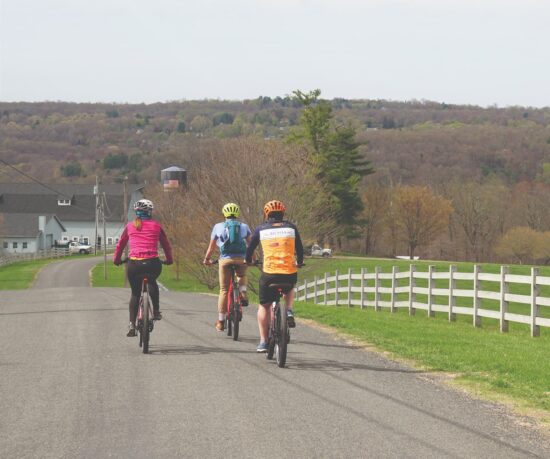
While my adventure took us around to the farms and historic sites of Bridgewater, KC & E organizes trips all over New England…

Farm to Farm E-Biking in Bridgewater

By Geoffrey Morris

Twelve miles per hour is really the ideal traveling speed to soak in the countryside. It’s fast enough to get you around, yet relaxed enough that you can take in that allee of trees or intricate stonewall design.

In fact, that was my average pace on a recent bike tour around Bridgewater, led by Collin Daulong, who with wife Caitlin, owns and operates KC & E Adventures, based at Mine Hill Distillery in Roxbury. While my adventure took us around to the farms and historic sites of Bridgewater, KC & E organizes trips all over New England, Iceland, Italy, and elsewhere, as well as rides for kids and families.

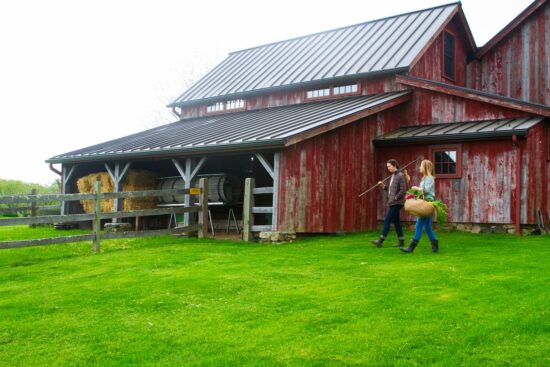
Our trip began at 9 am at Sunny Meadow Farm, with a brief overview by Collin, born and raised in Bridgewater, about the tour, the bike, and the area. It’s the Farm to Table Experience. Sunny Meadow has been continuously tilled for some 300 years under the tutelage of only four families—currently selling organic fruits, vegetables, grains, and poultry in its farm store and at farmers markets. The place is so gorgeous it’ll make you weep.

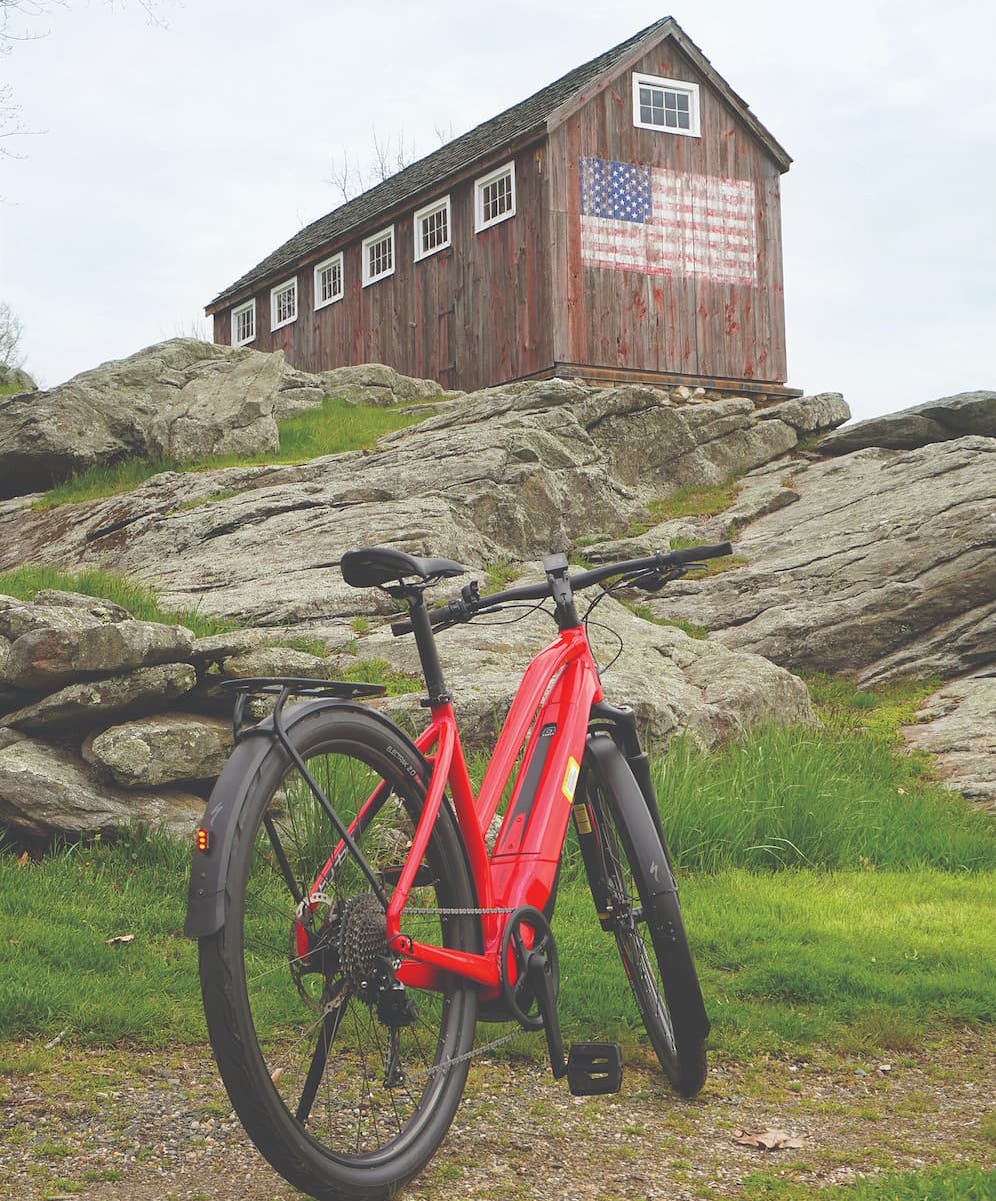
The bike for this tour is the Specialized Como—a ten-speed, $4,000 electric bike. The cycling experience on an electric bike is very similar to a traditional cycle—only way, way better. You pedal the bike, downshifting for uphills, upshifting for flat terrain. There’s no throttle. There’s no noise. It’s cycling.

The beauty of the e-bike is the assist on the hills. Even in first gear on a traditional bike, a mild hill becomes a heart-pumping workout—an adventure killer. You huff and puff uphill at 2 mph, not the magic 12 mph provided with the electric assist. Says Daulong. “Electric bikes allow you to explore more, in less time, and with less effort. Some of the hills we rode up are really steep. An experience like that would be limiting with a traditional bike.”

Which is helpful for our next stop at Maywood Gardens, a 40-acre private estate that provides fresh-cut flowers, vegetables, and field crops sold at the Bridgewater Village Store. Owned by financier Peter May, Maywood is a member of Audubon International and also produces wine from grapes grown on the estate—Chardonnay and Cabernet Franc, for those keeping score at home. While the tour does not go onto the grounds, the 12 mph pass-by puts riders at a nice height and pace to see the vineyard, greenhouse, and acres of natural beauty.

We also stopped at Greyledge Farm, which specializes in all-natural, pasture-raised beef, pork, and chicken. While the tour makes a few farm stops on its farm theme, cycling around Bridgewater is quite magical. If ever there were a town that practiced understated elegance, it’s Bridgewater. Grey, distressed siding, natural rolling hills, and soaring deciduous trees.
Zac Autio

The Farm to Table Adventure streamed us quietly to various stops, sneaking in a piece of chocolate and espresso at the Village Store in the center of Bridgewater, ending back at Sunny Meadow for a box lunch from The Smithy, in New Preston. Fresh sandwiches, Asarasi water culled from trees, and a figs-nuts-cheese platter.

Other tours include finishing-touch tastings at Mine Hill Distillery, Kent Falls Brewery, and Hopkins Vineyard.
In Gratitude 

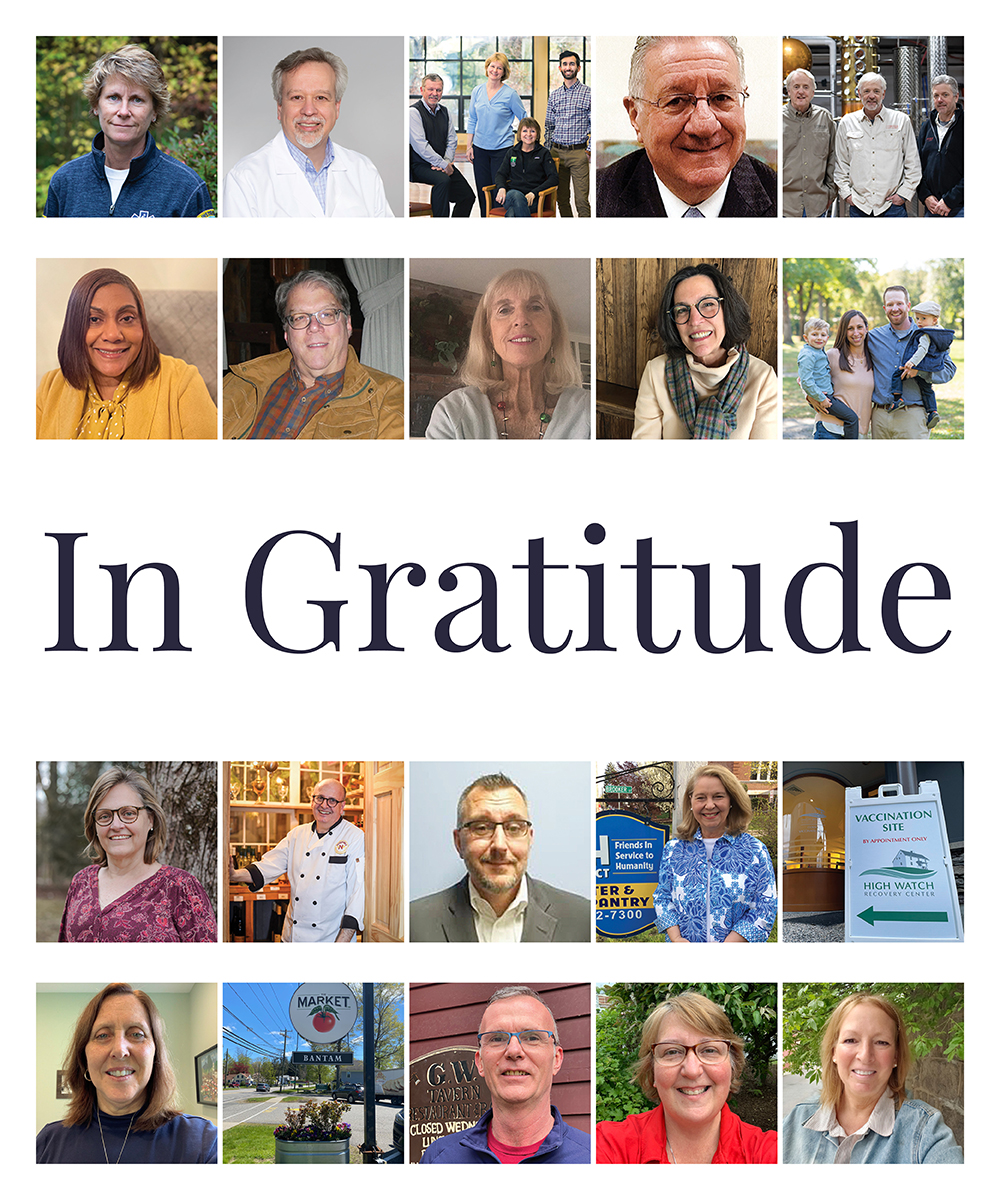
Instead of our annual list of the 25 Most we are shining the light on those who have been at the forefront helping others during the pandemic

Celebrating Pandemic Workers and Volunteers

Edited by Joseph Montebello

Instead of our annual list of the 25 Most we are shining the light on those who have been at the forefront helping others during the pandemic. This is but a sampling of the many local people who deserve our gratitude and appreciation for rallying during these troubled times. We thank you all.

Heidi Johnson, assistant chief of Washington Ambulance Association, led the all-volunteer Emergency Medical Services through the protocols and training to safely respond to the pandemic. Additionally she continued to work as an EMT in New Milford.

Dr. Paul Nee, infectious disease specialist at Nuvance Health, which includes Sharon and New Milford Hospitals, treated the first COVID-19 patient in CT and has been working 24/7 ever since. He has directed patient care and led all efforts to properly protect hospital staffs.

The Litchfield Community Center never closed its doors. Berta Andrulis Mette and her staff organized and collaborated with fellow organizations and volunteer groups to collect and deliver food and essentials to needy families and the elderly.

Owen Quinn, Director of the United Way of Northwest CT and former mayor of Torrington, took on the leadership of organizing the overflow of the homeless in shelters and arranged housing in the former St. Mary’s school building, offering them solace, safety, and food.

Litchfield Distillery co-owners and brothers Jack, David, and Peter Baker decided early on to pivot from spirits to producing hand sanitizer and donating over 100,000 bottles. They set up a donation jar and raised over $41,000, which was donated to FISH.

Maria Gonzalez is Director/Manager of Community Services at New Opportunities and was key in working with the homeless and hungry/food insecure, especially for the Spanish speaking population.

Dr. Kenneth Blazier, anesthesiologist at Charlotte Hungerford Hospital, has been treating COVID-19 patients who have suffered from the harrowing effects of the virus. He has been on the frontline of care and service round the clock, experiencing both death and recovery.

Kathy Minck started a Food Rescue program in Northwest CT in 2016. To date she and her team have delivered 1.3 million meals to needy individuals. During the pandemic her donations to local food banks have been a godsend to many neighboring communities.

Rosamond Quay has served as volunteer coordinator for The Pantry at St. Michael’s in Litchfield since its inception in 2017. During the pandemic she and her team worked tirelessly to feed those in need, relying on donations from the community.

Shelby Newkirk, assistant nurse manager for critical care at Danbury Hospital, made it her mission to keep patients in touch with their families via facetime and printing and laminating photos of patients with their families to quell loneliness and fear.

Michael Lyn Cappello serves as Litchfield’s Social Services Coordinator. During the pandemic she worked as a CERT volunteer distributing food boxes and grocery shopping for high-risk residents and assisting with vaccination schedules.

George Noujaim, owner of Noujaim’s Bistro in Winsted, created meals for FISH shelter and residents who were in desperate need of food and supplied the necessary ingredients to keep up the demand for meals.

Christopher Leone, Superintendent of School for Regional School District 6 and Litchfield Public Schools, orchestrated the reopening of schools and provided more in-person education than nearly every other school district and at the same time providing safety to students.

Deirdre Houlihan DiCara, executive director of FISH, kept the frontline services going and explored new sources for food and housing support despite a steep increase in requests and made sure that everyone who needed food and shelter received them.

High Watch Recovery, recognizing a need for vaccine distribution in the Northwest Corner, obtained licenses and approvals, bought proper refrigeration, and opened a clinic in Kent Barns, which vaccinated nearly 400 people each day.

Nancy Heaton has been Chief Executive Officer of the Foundation for Community Health in Sharon since 2004. During the pandemic, in addition to the usual services, she arranged and orchestrated grants to support the needs of people affected by COVID.

David and Deborah Brenner, of Bantam Market and Northfield Market, supplied free masks and gloves for the safety of their shoppers. They partnered with Food Rescue US NWCT and were the largest donors contributing fresh food to all the local pantries.

John VandenBosch, owner of G.W. Tavern in Washington Depot, gave away free dinners on Tuesday nights at the beginning of the pandemic and later offered a free dinner with purchase to share with a needy family.

Michele Martyn, working at a New Milford pharmacy, which is essential to the health of the community, made sure that everyone who required COVID assistance received it and answered questions and offered solace as needed.

Lori Kibbe Lindenmuth, clinical liaison for Elara Caring in Torrington, became a CERT volunteer and created a sewing group to make masks for hospital and front line staff. Her goal was 100; to date they have completed more than 5000.

Good Farming = Good Food

Nina’s vision for the farm was to create an organic farm that would offer a community supported agriculture (“CSA”) program.

Nina Patterson cultivates her organic dreams at Helmstead Farm

By Charles Dubow

What person with a moderately green thumb and a taste for fresh vegetables hasn’t driven by a charming country farm with its clapboard house, antique barns, and rolling fields dotted picturesquely with grazing cattle and thought, I could do that? To most people, this is just a passing fancy, a bucolic daydream quickly replaced by other musings. But not to Nina and Mike Patterson.

When they bought the old Back 40 farm on Lower Church Hill Road in Washington Depot last July neither of them had ever farmed before. They relocated to the area from New York City during the pandemic and Mike continues to work in finance. “This had once been a farm,” says Nina. “The previous owners had originally been gung-ho and built out the fields, but they lost interest and didn’t have the bandwidth to keep it up. When we bought it the land had been fallow for two years. So I decided to make a go of it.”

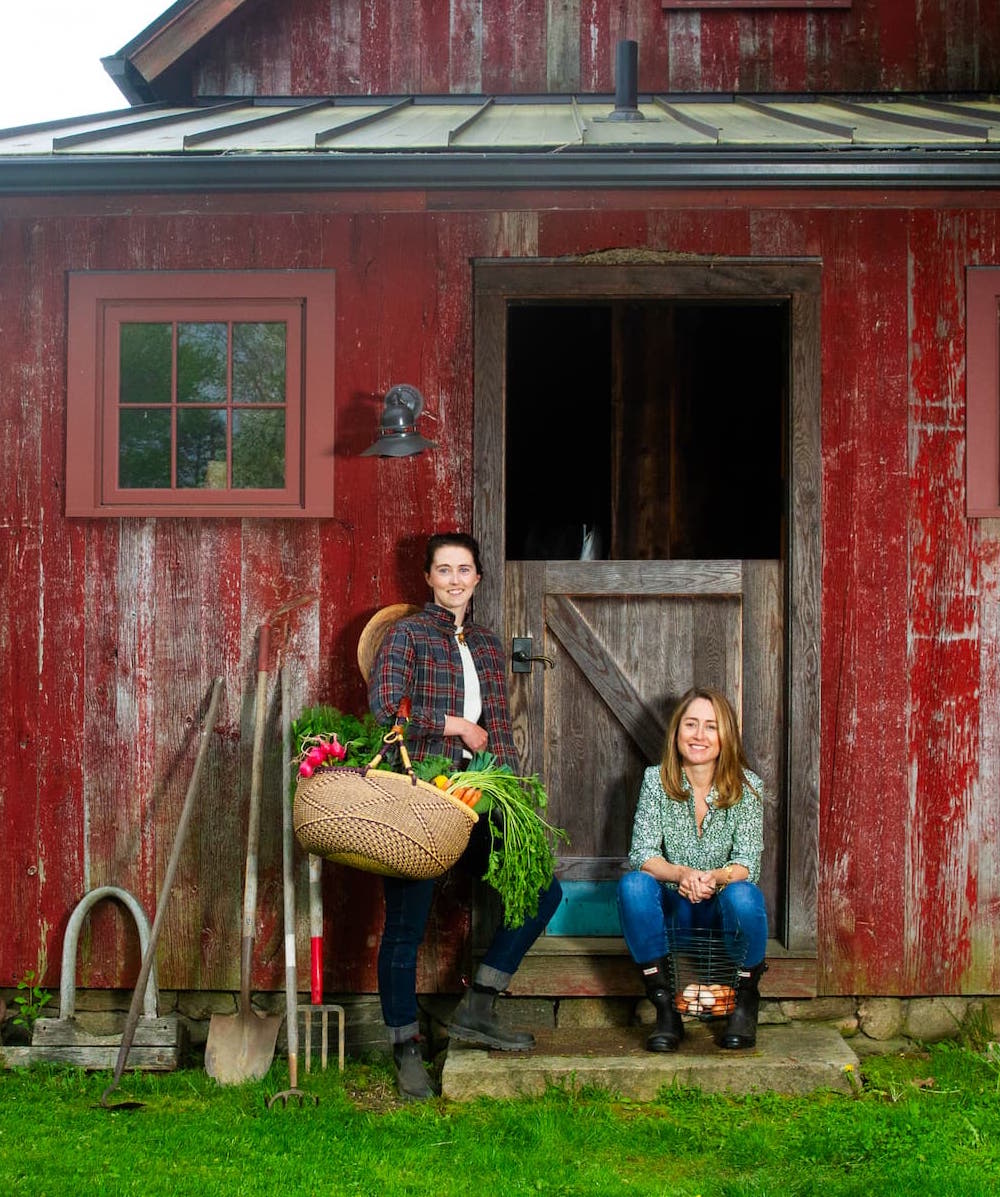
Nina’s vision for the farm was to create an organic farm that would offer a community supported agriculture (“CSA”) program providing nutritious vegetables, as well as flowers, honey and mushrooms, for local consumers and businesses. She and Mike dubbed it “Helmstead Farm,” which she says comes from the names of their three children: H for Henry, EL for Eleanor and M for Maddie. “And of course we liked the play on homestead—plus my husband was in the navy and he loves any maritime reference.”

Lara Foley

To help realize her dream, Nina brought on Enya Cunningham to be the farm manager. Together they have worked to update the farm’s outbuildings, restart planting and bring out their first produce. “We want Helmstead to be a regenerative farm,” says Enya. “We are transitioning to a low-till system that will focus on rebuilding the soil, reducing synthetic fertilizers and pesticides, and making it healthier. In the long run, it will make it less expensive to operate, as well as more organic. It just takes a lot more physical labor upfront.”

While the property covers 85 acres so far they are only growing on approximately three acres. “The eight-year plan is to continue to develop more of the land and eventually add in orchards, hedge rows and ruminants, which is all helpful to the farm’s biodiversity,” says Nina. “The hope with the CSA is to address not just organic farming but also food insecurity in the area.”

In addition to their CSA, the farm is currently working with The Mayflower, Troutbeck, and New Morning Market, as well as the Litchfield Farmers’ Market. Joel Viehland, the former chef at Swyft in Kent, is managing the crop list and the farm has been chosen to grow seeds for Blue Hill at Stone Barns. Already crops include garlic, tomatoes, fennel, winter squash, cucumbers, bok choy, escarole, cabbage and kale. Future plans include growing pawpaws, native persimmons, hardy kiwis, and hybrid chestnuts.

But the farm isn’t all work. “See this barn?” says Nina with a laugh. “It’s a working barn in the back and a party barn in the front.”

For more information about Helmstead Farm’s CSA, email enya@helmsteadfarm.com

Helmstead Farm
153 Lower Church Hill Rd
570-269-7645

Gabe McMackin: A soulful chef who keeps it real

These days, McMackin gets to take people on new culinary journeys as executive chef at Troutbeck, a hotel and restaurant in Amenia.

By Linda Tuccio-Koonz

Even as a child, Gabe McMackin was fascinated with food.

Not just where it comes from, but how it brings people together, creates memories.

Growing up in Woodbury, he recalls the sensation of settling into a patch of raspberries, “not worried about the poison ivy I was sitting in, but just gorging myself on raspberries because they were soooo incredible.

“That kind of thing, and to be able to say to somebody, ‘Come try this stuff!’ was amazing as a young person. And I never really lost that excitement for it.”

These days, McMackin gets to take people on new culinary journeys as executive chef at Troutbeck, a bucolic 250-acre property with a hotel and restaurant in Amenia.

Courtesy of Troutbeck

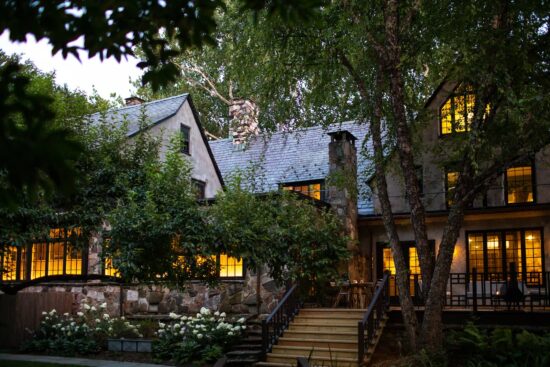
An estate, country inn, and tavern since 1765, Troutbeck has a storied past. Beloved by luminaries from Ralph Waldo Emerson to Mark Twain, it also counts Langston Hughes among its many notable visitors.

McMackin’s focus is on fresh, locally sourced food. He describes it as American cuisine, but cuisine that’s “aware of the foods of other cultures,” and cuisine that surprises.

“Summer brings vibrant salads with things like heirloom tomatoes, Habanada and Aji Dulce peppers, husk cherries and herbs. Roasted chicken with sweet corn and chanterelles is often on the menu, as is steelhead trout from Hudson Valley Fisheries with summer beans and littleneck clam panzanella.”

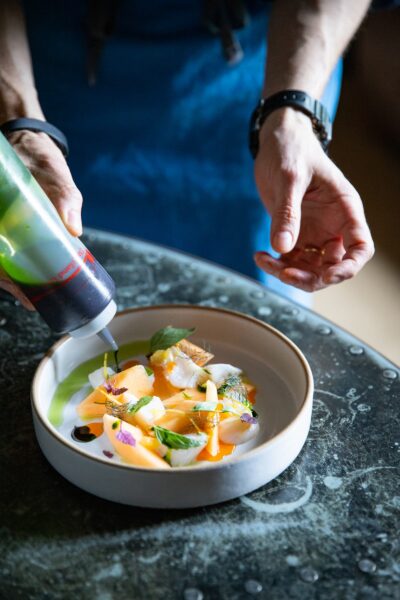
Foraged ingredients often contribute to beautifully plated dishes. “Whether you’re looking for salad and a glass of wine, or to celebrate a special occasion, the food has to feel good,” he says.

Matthew Mancuso

McMackin’s years of experience include work at The Mayflower and Thomas Moran’s Petite Syrah in New Preston, along with New York’s Blue Hill Stone Barns and Gramercy Tavern. He earned a Michelin star as chef/owner of The Finch, in Brooklyn.

Brooklyn is also where he and his family lived before returning to Woodbury in March 2020, when the pandemic hit.

“I was thinking we’d be here just a couple weeks and we’ve been here ever since. Unfortunately, I had to shut my restaurant in Brooklyn, but I was thrilled to be able to dig a little deeper at Troutbeck and really reconnect in a wonderful way…”

Looking back to early moments that influenced his career, McMackin says, “I remember things like my mom picking rhubarb when I was first learning to walk, my father picking pears off a pear tree, or being able to taste what a wild grape was like.”

In the beginning, while prepping food in restaurants, he learned to focus on ingredients. He saw how experimenting with changes, such as adding cheese, influenced flavors and textures.

Matthew Mancuso

Some of that experimentation was inspired by his years at Washington Montessori School, where exploration is encouraged.

“I started going there when I was five and a half,” he says, of the school where his mother still teaches music. “My son, Jasper, is now five and a half and at the same school for his first year. It’s an amazing thing to be able to send him there.”

McMackin’s fascination with food continues with each tweak of Troutbeck’s seasonal menus.

“What I’m most proud of is our incredible team,” he says. “We put our heads together and say, ‘What can we do with this stuff that’s great, and that people are going to love to eat?’ And that’s what comes out.”

Making Pottery

Herold does her thing in the country confines of West Cornwall, makes wheel-thrown, wood-fired, and gas-fired dinnerware and other pottery.

By John Torsiello

Jane Herold, owner of Jane Herold Pottery, is feeling upbeat about 2021; and why not? The “chefs are returning,” ordering plates and bowls, and over the past year she’s been making dinnerware for “local people,” which has been “a lot of fun.”

“We work out the shapes, sizes, and colors together,” Herold says of her personalized dinnerware. “It leads me to new ideas, and keeps it lively for me. I also had a little time in 2020 to experiment with some new clay bodies that led to even more new dinnerware options.”

Herold, who does her thing in the country confines of West Cornwall, makes wheel-thrown, wood-fired, and gas-fired dinnerware and other pottery. She’s been doing so for over 30 years. Her work is intended “for everyday use and making every meal a pleasure.”

Herold plans two open houses later this year (one was held in May); one in October, the weekend after Indigenous Peoples Day (aka Columbus Day weekend), October 16 and 17; and another in December in that festive month’s first two weekends.

“The October event is linked to the Clay Way Studio Tour, which I am co-chairing this year,” says Herold. “We have nine pottery studios open and most studios invite guest artists to join them, so we’ll have about 18 potters exhibiting over those two days.” Those wishing details about the October tour can contact Herold through her website.

Jane Herold Pottery on Sharon/Goshen Turnpike is “always open by appointment or chance.”

Trails of Life

The small markers on trees delineating Sharon Audubon property gently reminds me that we share this land and forest with its inhabitants.

An executive finds a way to help others via Sharon Audubon Center

By Claudia Malley

The bluebirds always appear around April 1. I spot them on the fence in the field, and if I’m lucky they will fly to one of the trees outside my porch. Some are migrating, others have just been hiding all winter. Seeing them each spring reminds me of how much I love living in the northwest corner of CT. At times I feel like I am a character in a nature documentary, with chirps, squeals, warbles, drumming, and hoots creating an incredible bird-call symphony, a performance that forces me to slow down and listen.

The land surrounding my house in Sharon was gifted to the Sharon Audubon Center by my neighbor Lois Webb, who, like many others in the region, believed in the importance of preserving and protecting land. As I walk through the woods, the small markers on trees delineating Sharon Audubon property gently reminds me that we share this land and forest with its inhabitants, especially the birds.

I learned early that I would be more successful and satisfied in life if I could infuse work with my passions—do what you love, love what you do. I spent 16 years at the National Geographic Society, working to raise support for their mission to inspire people to care about the planet. The scientists and explorers who worked with Nat Geo helped me appreciate the role we all play in making sure our world is protected for future generations.

With the pace of life slowing to a halt during our covid year, I began to not just hear the bird calls, but to think about how I could become more involved with my neighbors, the Sharon Audubon Center. I’ve lived in Sharon for 25 years. I love these forests, and nothing gives me more delight than hearing, then spotting, a brightly colored woodpecker tap-tap-tapping away. I wanted to help others experience the sounds and sights that bring me so much joy.

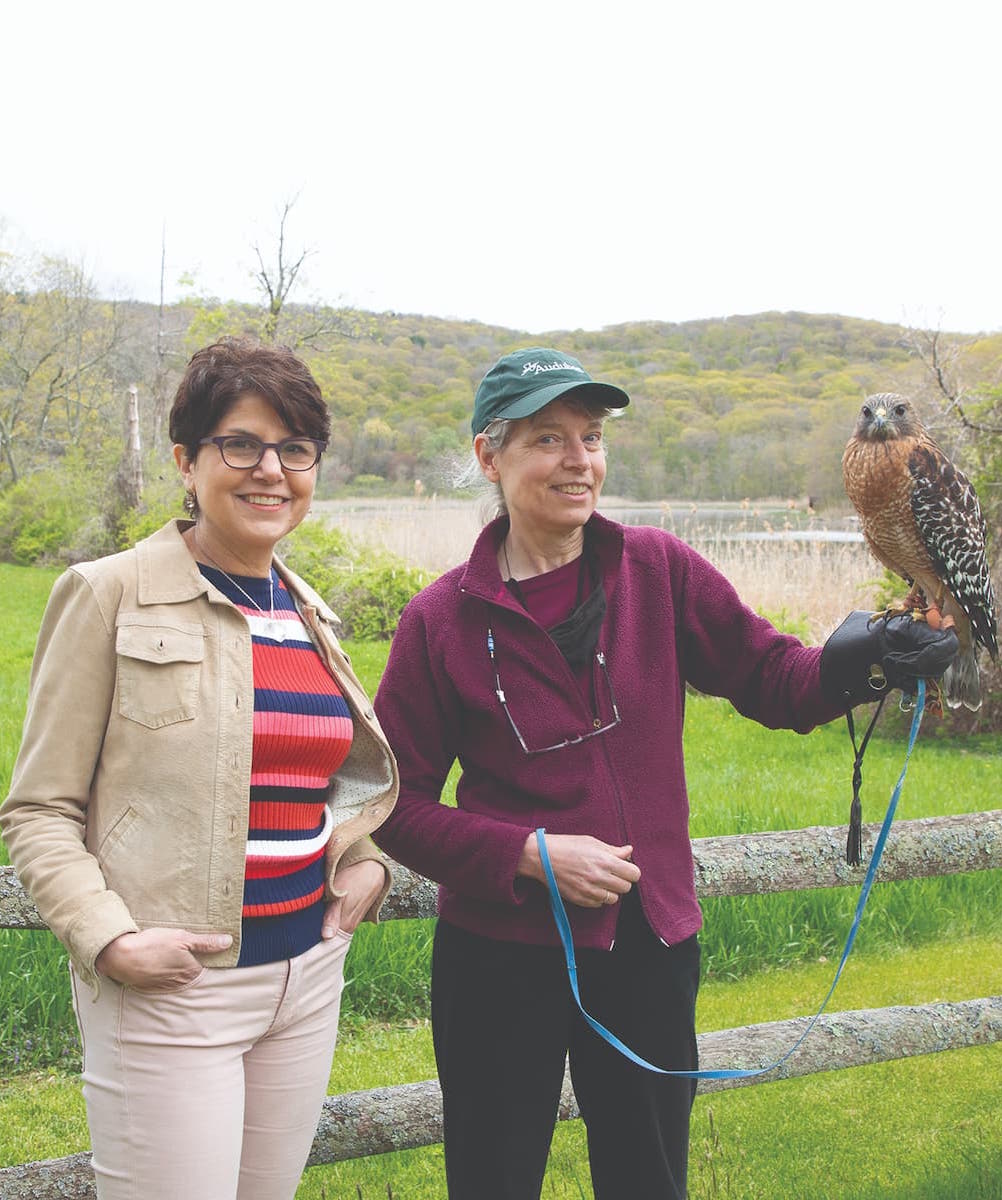
One cold spring morning in 2020, I met Eileen Fielding, the Director at Sharon Audubon Center. With masks covering our faces, we walked the Fern Trail around Ford Pond and talked about her vision for building a vibrant community outpost. She was curious and funny and exuded commitment. I was also awed by her ecological expertise. I learned about the education and rehabilitation efforts of the Center’s small but mighty team of experts and volunteers, and Eileen outlined how Sharon Audubon Center fits into the National Audubon’s efforts to manage forests, wetlands, and flyovers. With my purpose-based marketing hat on, my mind quickly filled with ideas of how I could help.

Connecting with the Sharon Audubon Center took longer than it should have. But now, as a member of the Sharon Audubon Advisory Board, I’m doing what I love and love what I’m doing. I not only help share the Audubon’s work with others in the community, but also, much like my work at National Geographic, I can help make sure the birds have the habitats they need for generations to come.

It’s funny how you might think you are on one path in life, and if you take a moment to stop and listen, you see that the path is actually a network of trails filled with life and potential—and the sounds of birds in the trees.

A Homecoming

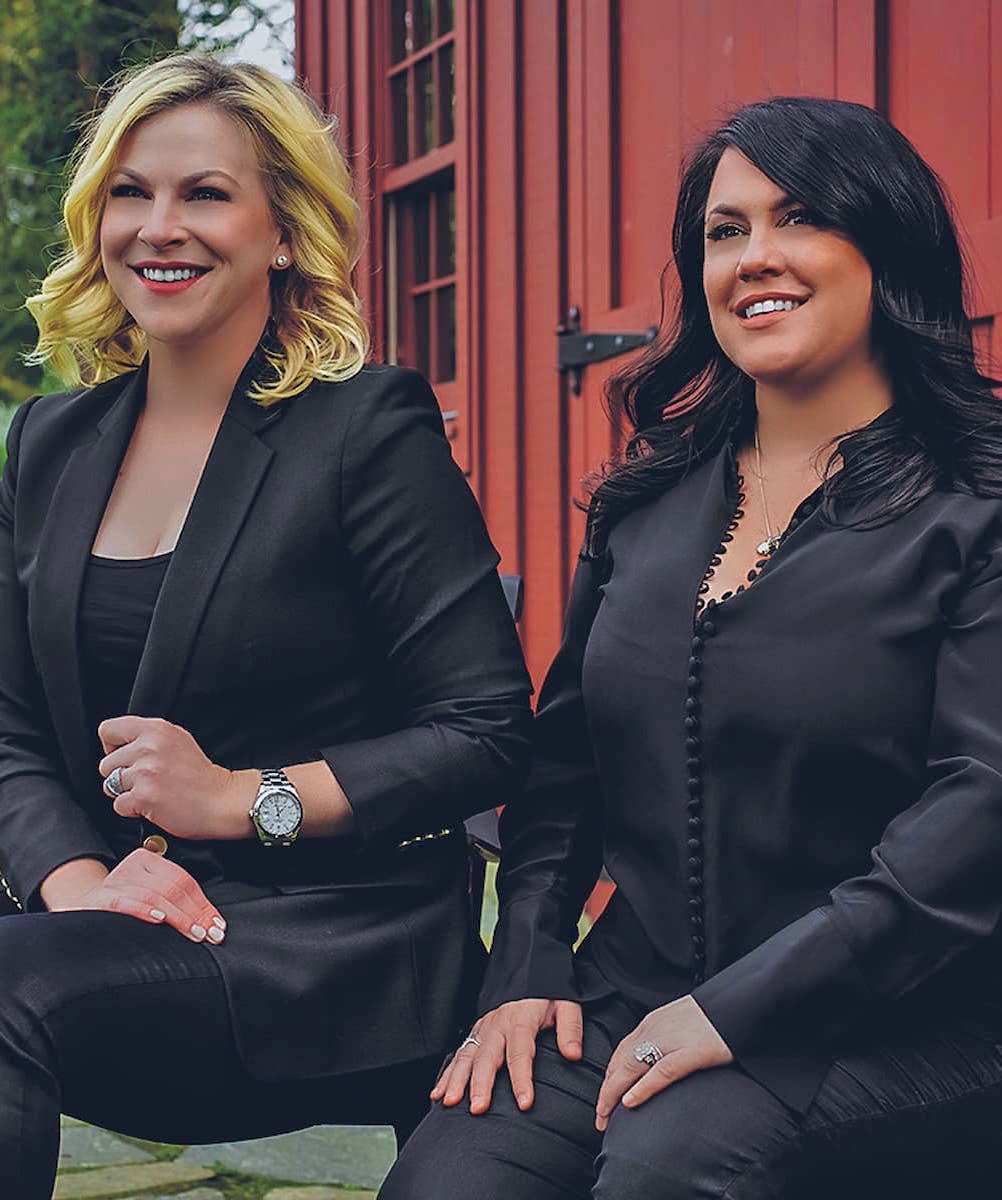
Taylor Spellman’s passion, attention to detail, and artistic touch have revolutionized decor concepts since she launched her company.

NYC design firm gets back to their roots

By Clementina Verge

SPONSORED CONTENT

Taylor Spellman’s passion, attention to detail, and artistic touch have revolutionized decor concepts since she launched her interior design company in New York City 15 years ago. The Connecticut-born entrepreneur successfully grew her business from staging homes to starring in television shows—achieving national recognition and praise for her accomplishments. She is  excited to expand her brand, bringing enthusiasm, proven experience, and a comprehensive team to Litchfield County.

The move goes beyond business strategy. Spellman is currently seeking to establish residence in the area, while her lifelong friend and chief of staff Kate Wasserman Dickens has already settled here. The two met in kindergarten and have fond memories of Litchfield County, including Girl Scouts camping trips at White Memorial Conservation Center. Praising the area for its architecture and landscape, they strive to honor its uniqueness by drawing inspiration from it, along with creating spaces that reflect individual lifestyle choices, whether these include frequent entertaining or a preference for quiet evenings reading by a fire.

“Many designers insist on their own style, on making things basic and beige, and playing it safe, and I disagree with that,” Spellman explains. “The focus should be on designing homes for prospective buyers or current residents. I value figuring out who the person or family is and building the design through the client, not for the client.”

Spellman’s project portfolio and expertise have been praised across the nation. After appearances on Bravo’s “Yours, Mine or Ours” and “Million Dollar Listing,” she stars in the HGTV series “One Week to Sell,” where with a small budget and tight timeline she stages homes for quick sales.

In the past year, Spellman has also worked with homeowners looking to recreate personal spaces that accommodate lifestyles affected by the Covid-19 pandemic.

“We have clients who have set up home offices or turned part-time homes into full-time residences,” Spellman explains. “No one will ever look at their homes or properties the same way.”

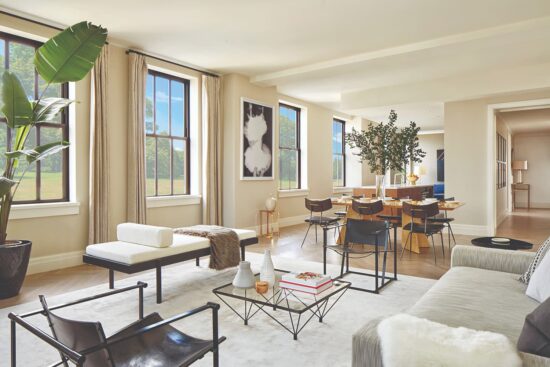
A project may include anything from new light fixtures or fresh shades of paint, to acquiring new furniture, finishing floors, and remodeling kitchens. Particular about every detail, Spellman also places high emphasis on art, often completing pieces customized to each space.

“Art truly makes or breaks a space,” she notes. “It is highly personalized, so we make our own pieces, whether these are bold acrylic, subtle watercolor, vintage photography, or mirror collages. Everything is curated to enhance the feel of the home.”

The overall experience proves to be part of the “white glove service” and “one stop shopping.”

“We manage the entire process,” Dickens assures. “We have a great team that will see a project from start to finish. Our clients can be confident that our millworkers, contractors, or anyone who enters their home is vetted and trustworthy. We are only as good as our word and quality of work. That has been the key to our success and we look forward to bringing that to Litchfield County.”

Electric Bikes

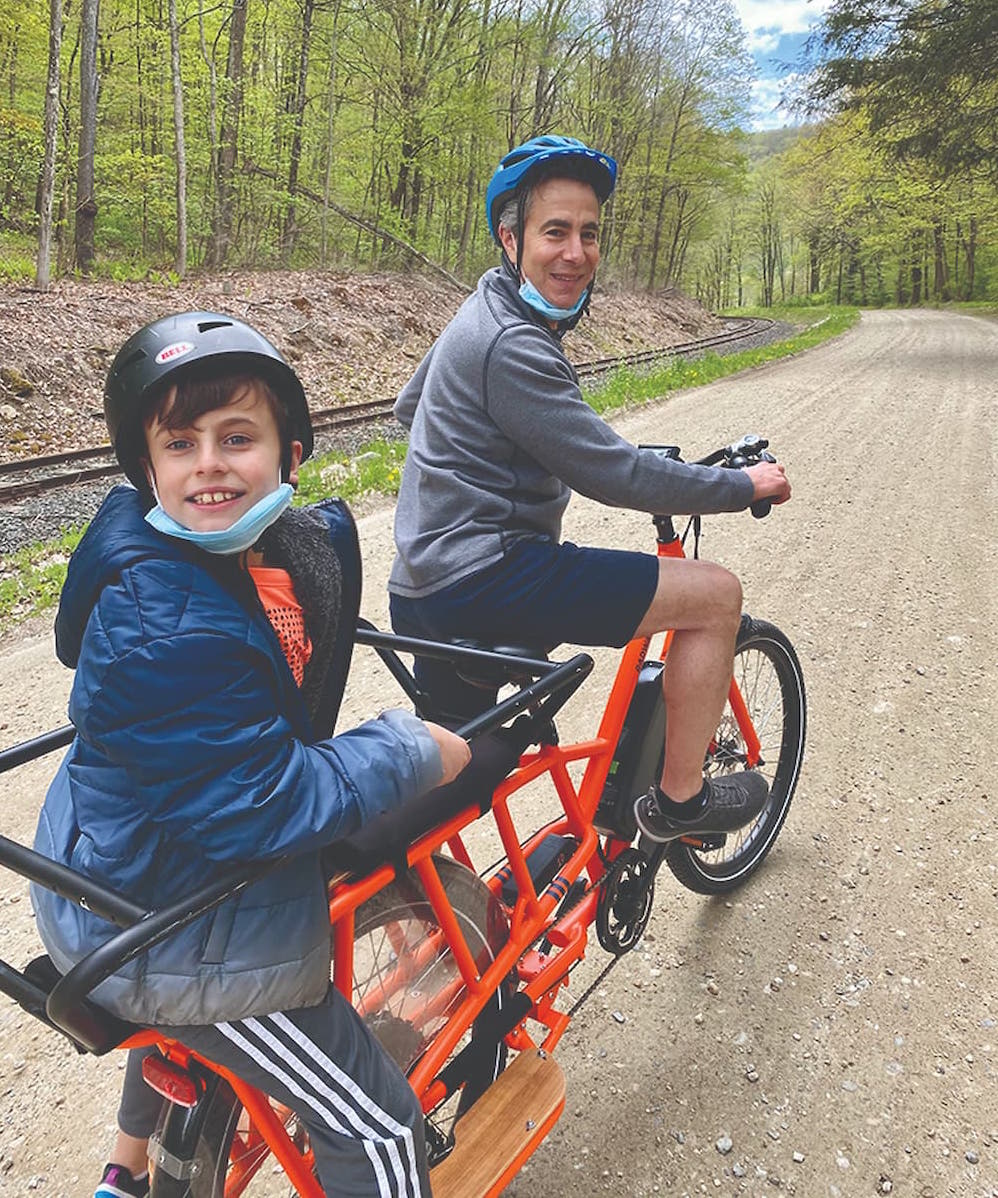
Covered Bridge Electric Bike rents by hour increments that can stretch to all-day trips. Some of the E-bikes have rear seats for small children to ride in.

By John Torsiello

Need a little assist with your bicycle up a tough hill? Well, Bob Ensign has you covered.

The owner/operator of Covered Bridge Electric Bike in West Cornwall rents E-bikes—a modified bicycle that looks and functions like a traditional bicycle with a major caveat; users can tap into a small electric motor that can help power the vehicle up steep hills.

Litchfield is a great place to bicycle, says Ensign, but there are a lot of steep hills that deter some people, especially those who are a bit older or have some physical limitations. “The electric bikes allow people, anyone really, to get back out and enjoy riding again. When you need an extra boost to get up a hill you can very simply adjust the motor to produce that assistance, and when you are coming down a hill or on flat ground you back off on the assistance.”

One of the favorite routes for renters of E-bikes from Covered Bridge Electric Bike is along scenic River Road that runs fairly close to the Housatonic River leading into Massachusetts. I went for a ride and loved the E-bike’s ability to help me climb several hills, acting as a traditional bicycle when I wished. The tires on the E-bikes are wider than those on traditional road bicycles, which lent stability and security to my ride.

Covered Bridge Electric Bike rents by hour increments that can stretch to all-day trips. Some of the E-bikes have rear seats for small children to ride in.

Covered Bridge Electric Bike
421 Sharon-Goshen Turnpike
West Cornwall
860-248-3010

Benson’s Beans

Benson acknowledges that despite the enormous pleasure he derives from making and consuming coffee, running a small business has its challenges.

Zero Prophet Coffee’s unique blends

By Harry Harwood and Charles Dubow

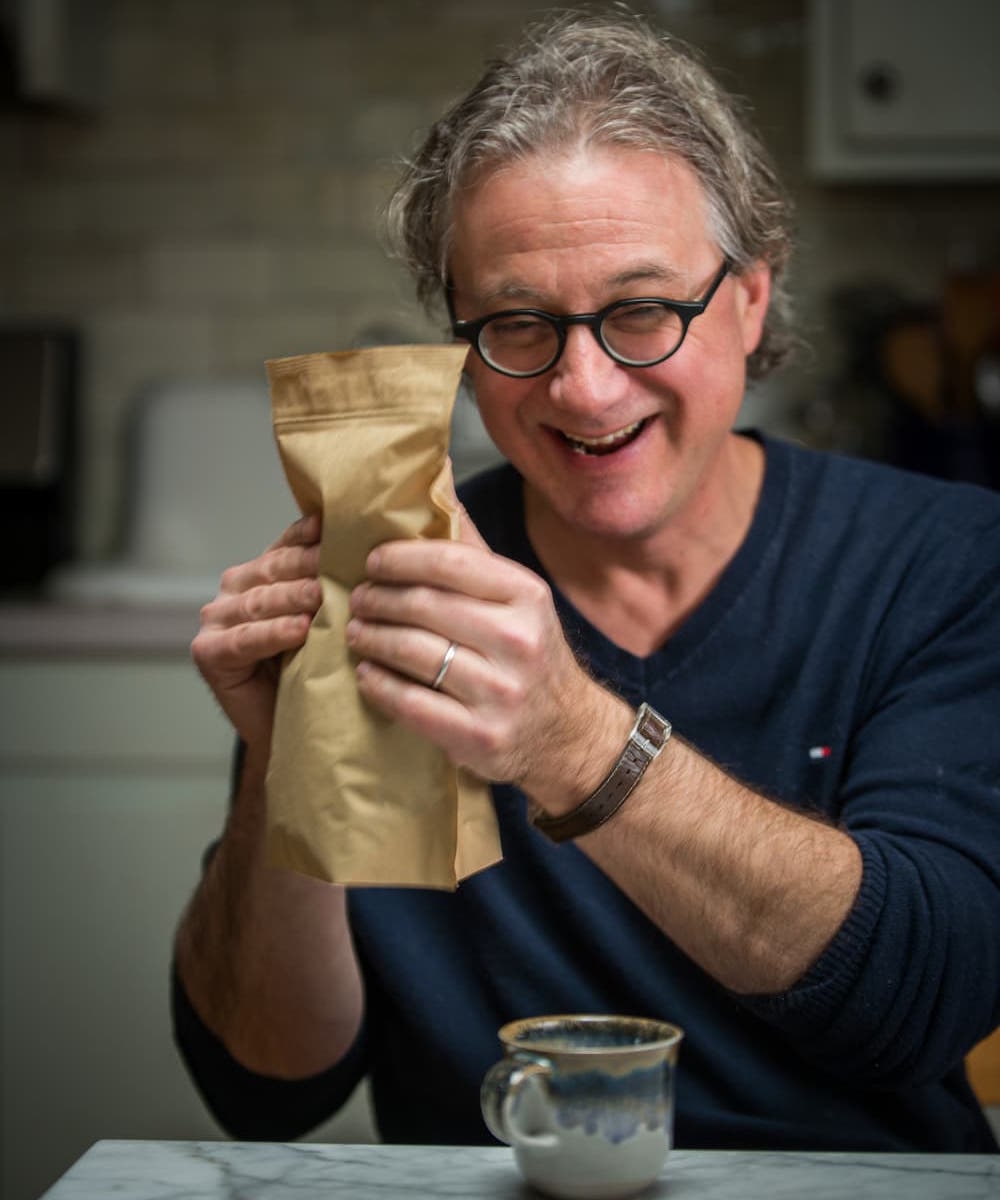
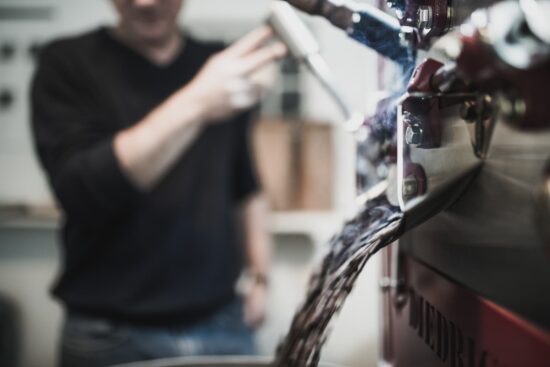
There’s coffee—and then there’s coffee. Too many of us throw money away at Starbucks or Dunkin’, happy to sacrifice taste and calories for that quick, easy jolt of caffeine. But for aficionados there is a deeper, richer, altogether more satisfying experience that comes only from brewing up the finest roasted beans and savoring the beauty of a truly well-made—and organic blend. That is how Nicholas Benson, the founder of Washington-based Zero Prophet Coffee, believes coffee should be enjoyed.

Jake Snyder, Red Skies Photography LLC

Benson, a Middlebury grad who is also a translator and English teacher at The Frederick Gunn School, started roasting beans in his kitchen in 2007 for the enjoyment of himself and friends. “I love coffee and wanted to share my roasts with others who share my passion. I began to sell more coffee under the table and soon it made sense to start selling in a store. But to do that I had to make it into a proper business. That meant getting on the books, paying taxes. But if I didn’t do it the right way then I couldn’t get coffee to people who need it.”

The name and logo for “Zero Prophet Coffee” came to him while doodling during a slow meeting. “I could already tell that it wasn’t going to make a big profit, so the prophecy was that it would be a zero profit,” he says with a smile. Instead of focusing on profits, Benson instead donates much of them towards local and environmental causes like Clean Ocean Access, Steep Rock Association, and a Honduran-based charity that helps stray dogs.

He sources his beans from Africa, Indonesia, and Central and South America. They are all certified organic, and the majority are Fair Trade. He loves to experiment with different beans and roasts. Currently he offers 17 different blends. Richness, liveliness, density, balance, and depth are what he says make a great coffee. Benson explains that occasionally a single varietal can have these layers, but it is more reliable to create a unique taste by blending different beans.

Jake Snyder, Red Skies Photography LLC

“I love finding three beans that together achieve something like a layer-cake—typically a base that’s like chocolate, an earthy caramel layer, and something more unusual or intense that might not be as pleasing on its own.” For example, one of his blends, the rich, full-bodied Torrefazione (Italian for “roasting”) Washington, contains beans from Sumatra, Java, and Nicaragua.

Benson acknowledges that despite the enormous pleasure he derives from making—and consuming—coffee, running a small business has its challenges. “I wish I didn’t have to worry about things like book-keeping. I’m not exactly a natural accountant. Maybe one day if we get big enough I’ll be able to hire someone to do the number-crunching for me.”

Jake Snyder, Red Skies Photography LLC

In the meantime, he is happy to just keep on making great coffee. Currently Benson’s beans can be purchased through his website or at Litchfield area shops and restaurants, such as the Washington Food Market, The Smithy, The Po, New Morning, Community Table, and elsewhere.

Zero Prophet Coffee
273 Sabbaday Lane (office)
860-207-6382

Volunteer EMTs

Most Litchfield County towns have volunteer EMTs and firefighters, but the departments are partly funded by state and local taxes.

We’re all in this together

By Elizabeth Maker

Don’t be surprised if you go to pay your taxes at Roxbury Town Hall, and the tax collector suddenly takes off. Or, if you’re a student at an area public or private school, and one of your teachers gets a call and has to run. Or, if you’re attending a church service, and the minister must exit the altar, disrobe, and drive away.

Such is life in Litchfield County, where hundreds of heroes have full-time jobs, yet volunteer around the clock to rescue their neighbors from accidents, illnesses, overdoses, fires, fights, and falls. The local grocery store clerk might be the EMT who shows up when you’re having chest pains; your banker, plumber, or landscaper might be the firefighter who douses your house fire.

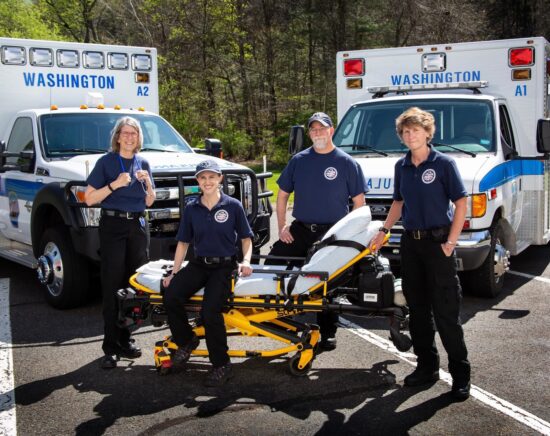
“Often we’ll get a call, and I don’t recognize the address, but I get in the house and there are all these familiar faces,” says Morgen Fisher, a volunteer EMT with the Washington Ambulance Association and a science teacher at the Frederick Gunn School. “A lot of people don’t realize that EMTs around here are regular folks with jobs in the community, who also happen to sleep with their radios on and their uniforms next to their beds so they can jump to a call at 2:30 am.”

Since the Covid pandemic hit last year, ambulance and fire associations around the county’s 26 towns report record high numbers of calls. In Washington, emergencies have doubled over the past decade, with 2020 setting a record of 408 calls. “And that’s not even counting 2021, which has been insane,” says Heidi Johnson, a professional photographer, who is an EMT in Washington and Warren, and is a part-time staff member of New Milford Community Ambulance.

Heidi Johnson

The call spike has largely been caused by the huge influx of New Yorkers since Covid hit, says Jacquie Rice, chief of the Salisbury Volunteer Ambulance Service. “We had over 500 EMS calls in the 2020 calendar year, and we’re normally about half that.”

Salisbury and Washington are two of the few remaining towns in Connecticut to offer free ambulance services, 100 percent funded by the community. Most Litchfield County towns have volunteer EMTs and firefighters, but the departments are partly funded by state and local taxes, and patients are charged for services. “We’re not even a line item on the town’s budget, that’s how free we are,” says Rice, adding that Salisbury’s ambulance department is celebrating its 50th anniversary this summer. “We get calls from patients afterwards, saying, ‘Where’s my bill?’ I say, ‘It’s free. You’re not going to get a bill from us.’”

While some emergencies have involved people with Covid symptoms, many have been due to the quarantine’s myriad side effects, including anxiety, alcoholic issues, drug overdoses, and suicide. “We had a 10-year-old boy who was having a breakdown. The whole disruption of his routine was really rough,’ says Kim Pokrywka, Roxbury’s tax collector, who’s been a volunteer EMT for 13 years. “We had a young girl who was addicted to heroin. We took her to the hospital three times. She would talk to us and say how much she wanted to quit, but couldn’t. She was really upset about Covid. The third time, she died.”

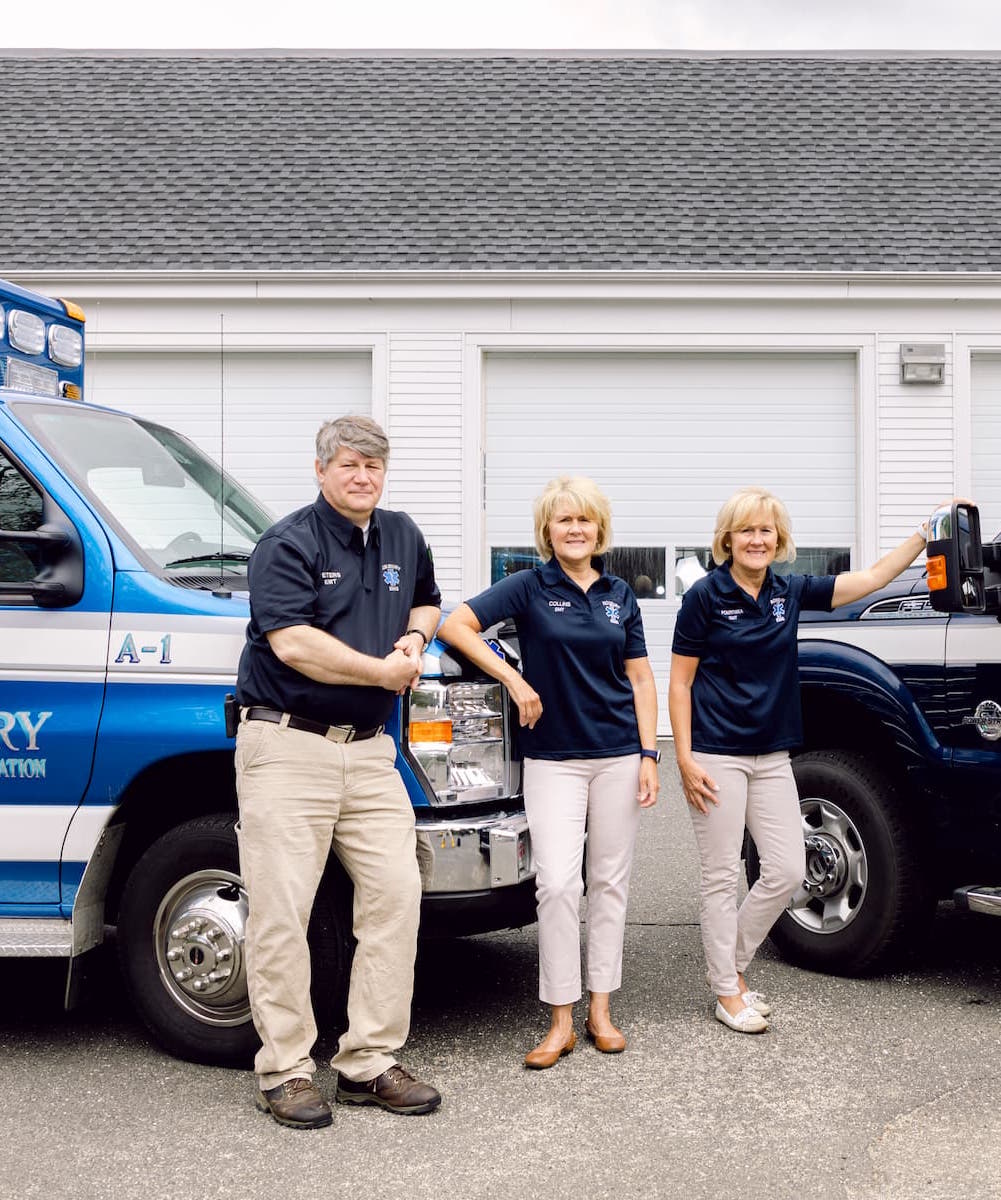
Pokrywka and her twin sister, Kaye Collins, also a Roxbury EMT, are among many responders who have been trained to administer Covid vaccines. The twins also went on a mask-making binge when the pandemic peaked. They sewed over 300 masks and delivered them door-to-door in the Roxbury emergency truck that was donated by actor Denis Leary (of “Rescue Me” fame) and his wife, Ann, who was a volunteer EMT when the couple lived in Roxbury.

The tax collector says it’s no problem to bail at work. Her boss, First Selectman Barbara Henry, who has also been trained as an EMT, “is fine with it,” Pokrywka says. “We’re in a small town, and we’re all in this together.”

For clergy like Linda Williams, pastor at Salem Covenant Church in Washington, and David Peters, minister at Roxbury Congregational Church, being a first responder often means swapping roles from medically treating patients, to emotionally and spiritually helping heal families, friends, and other paramedics from traumatizing calls. Williams mentions a recent three-car crash in Bantam that left two injured and one dead. “It was a horrific ordeal, with a very bad outcome,” she says, adding that she planned on proving a “critical incident debriefing” for her fellow volunteers.

“In a sense, the church loans me out to the community,” says Peters, who’s been a Roxbury EMT for 33 years. “The minister lives in the fish bowl. We’ve got quite a few parishioners who are also EMTs, so when we get a call, we might have to get up and go.”

Being an EMT, with the hundreds of hours of training and 24/7 calls, can be trying for families. “I’ll be out working with my wife in the garden on a Saturday afternoon, and a call comes in,” says Jim McDonough, a special education teacher at Shepaug Valley High School. “She’ll be like, ‘Fine, ok, see you whenever.’ But really, she’s great with it. She’s on board with the town’s motto: ‘We’re in it for the outcome, not the income.’”

Current Issue
March / April 2026
Our Kind of Healthy
The Health & Wellness Issue
Subscribe Now
.
  • STAY IN THE KNOW

    Your weekly guide to can't-miss events, hidden gems, and local favorites in Litchfield County. Sign up now for curated things to do, eat, and explore—delivered every week. It’s free. It’s local. It’s essential.

  • Karen Raines Davis