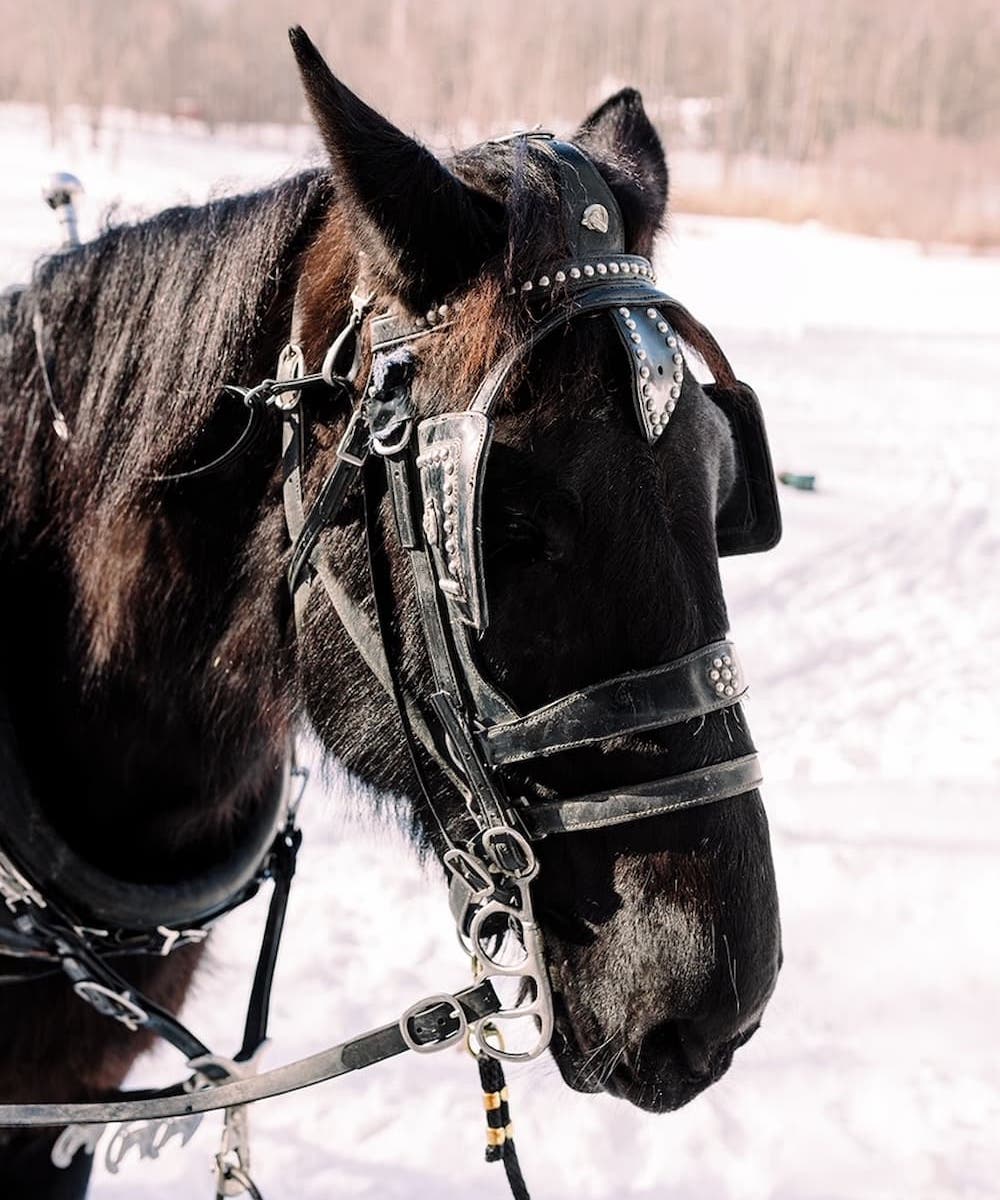
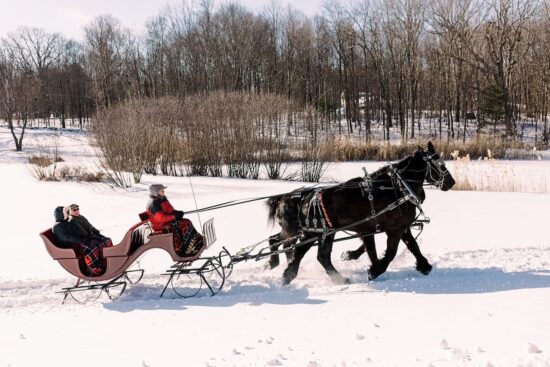
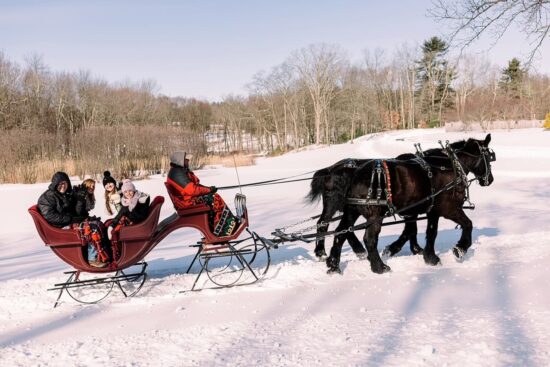
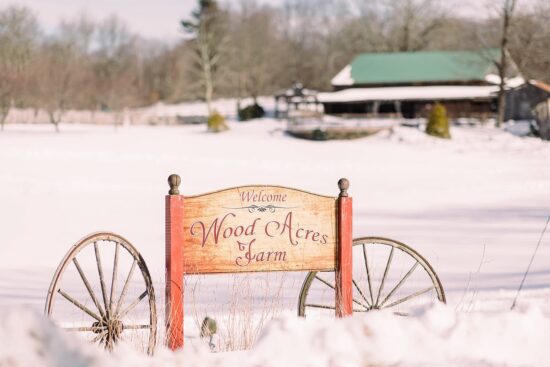
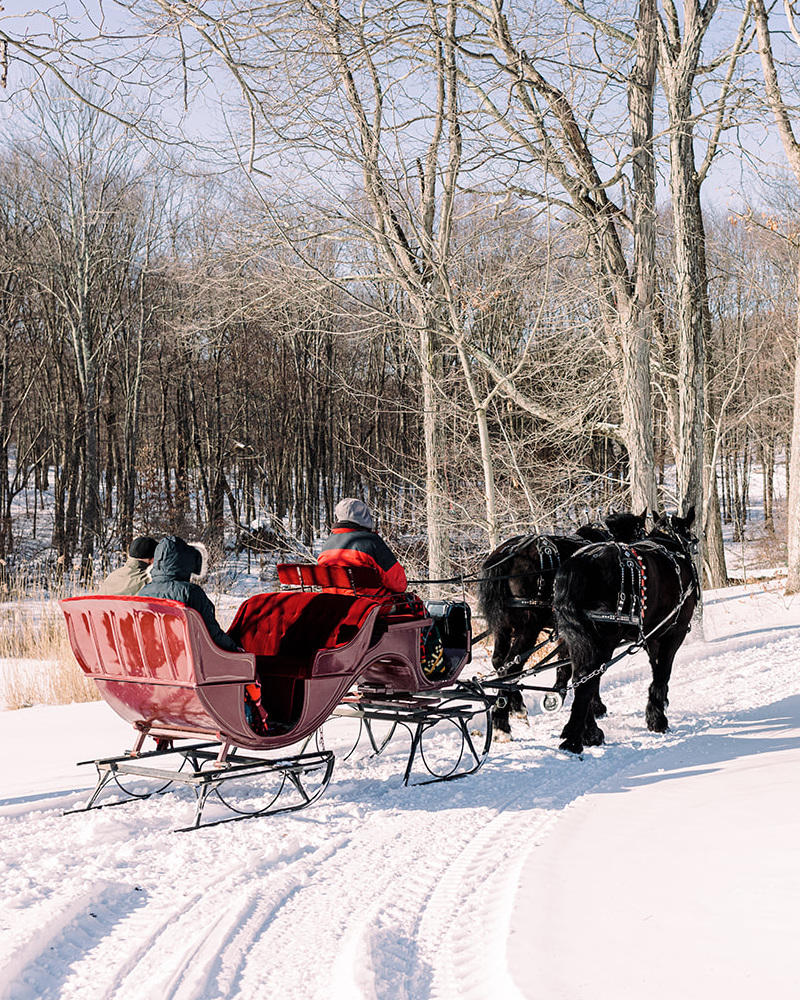
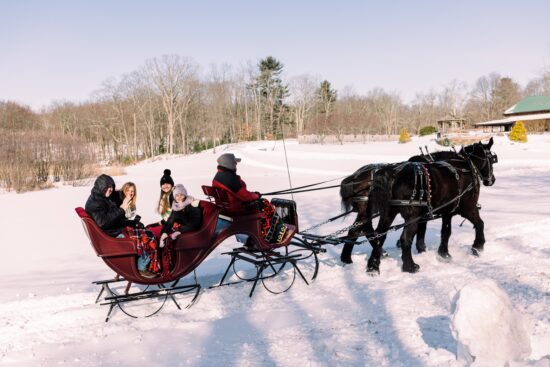
Horse-drawn sleigh rides at Wood Acres Farm in Terryville offer a timeless winter escape filled with romance, tradition, and quiet magic.
By Linda Tuccio-Koonz
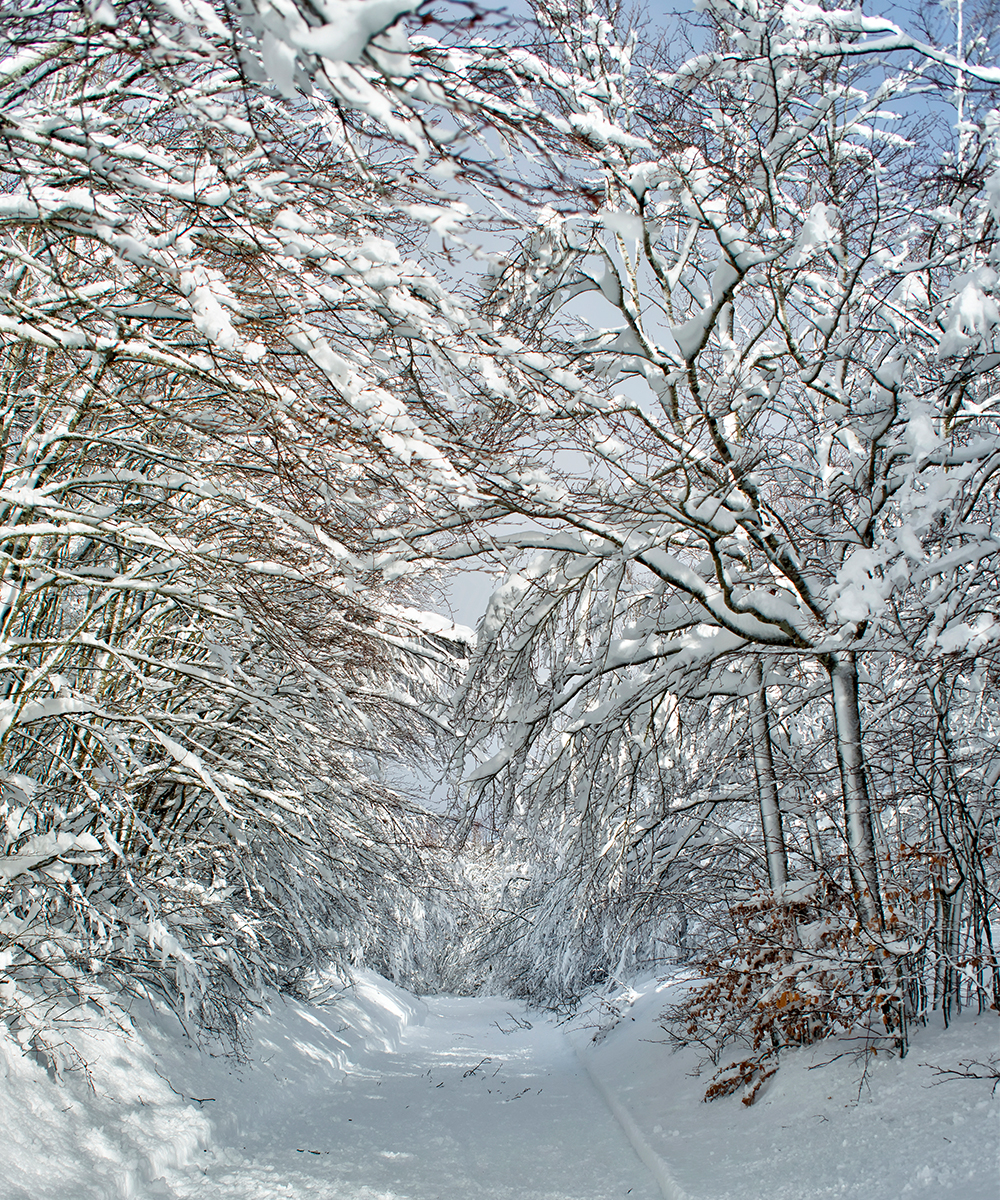
Ken and Joyce Wood love the wild beauty of a winter snowstorm—every branch of every tree coated in sparkling splendor. Then, when the fields and wooded trails of their Terryville farm are blanketed in white, at least six to eight inches deep, it’s time to harness the horses for sleigh rides.
“People hear the words ‘sleigh ride’ and seem to just light up and think it’s a romantic thing, and it is,” says Ken, who grew up on Wood Acres Farm, where elegant Percherons make the magic happen. “It’s a winter wonderland out there.”
The 25-acre property—like a Currier and Ives scene, with two ponds—has been in his family for five generations. Ken, a farrier, began running sleigh rides in 1972; they do more than 200 in a good season.
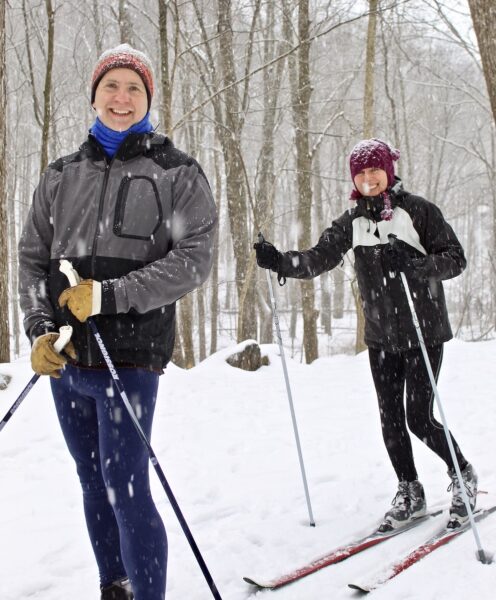
Joyce, who is not a skier (she laughs at the idea of it), says winter can be challenging for outdoor fun, but sleigh rides are enjoyable for all ages. Visitors love the experience because it’s a chance to “slow down, get off your phone, and enjoy nature.”
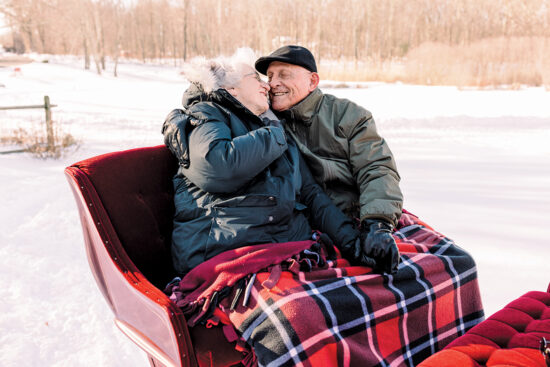
Families, large groups, and couples reserve rides—some celebrate birthdays or other occasions. There’s even been wedding proposals; Victorian-style sleighs set the mood.
When couples come, Joyce invites them inside the cozy farmhouse that serves as the office for their business (Wood Acres Farm is also a wedding venue). Music plays and candles glow.
“I give them blankets (warmed in a dryer) as they go off on their ride,” says Joyce, who knows many of the farm’s visitors cherish this old-fashioned experience as a bucket list item.
Jacek Dolata
Afterward, she serves cookies and hot cocoa. “I love watching them get warmed up and listening to their stories about going off into the woods, especially after a freshly fallen snow.”
If you call for a reservation, you’ll likely reach longtime office manager, Taylor. She’ll answer your questions about everything from what to wear—dress warmly; they recommend snowsuits for kids—to how long you’ll be out—figure 35 to 40 minutes.
Jacek Dolata
“There’s absolutely something magical about traveling via horse and carriage,” Taylor says. “There’s a quietness to it. You feel like you’re floating on the snow. It feels like you’re going back in time, and you get those rosy cheeks…”
Taylor especially enjoys when couples who were married on the farm return for sleigh rides with their growing families. “We get to see their kiddos, and how their love story is continuing.”
Jacek Dolata
Terryville residents Fred Messenger and his wife, Exelda (friends call her Zel), say they’ll never forget their sleigh ride. Fred gave Zel a certificate for her birthday. She’d wanted to go since she was a child, even more after seeing such classics as White Christmas and Dr. Zhivago, plus Hallmark creations.
“He surprised me; I never even realized there was a place (in Terryville) that did this with beautiful carriages and majestic horses. They put a blanket over us and we were one with nature.”
Ken says he’s always loved working with horses, and recently found himself with a great side gig. When not taking the reins at Wood Acres Farm, where carriage and wagon rides are always available, he drives horse-drawn carriages in HBO’s historical drama, The Gilded Age.
Set in 1882, this captivating series follows the lives of New York’s elite, including an aristocrat played by Connecticut’s Christine Baranski. Filming for season two began in May. Ask Ken about it, or anything involving the farm, if you visit for a sleigh ride. He’s happy to share. —woodacresfarm.com
In Litchfield County, it truly takes a village—and now more than ever, our neighbors and local organizations need support.
In Litchfield County, it truly takes a village—and now more than ever, our neighbors and local organizations need support. Across our towns, nonprofits do incredible work helping people and animals alike, but they can’t do it alone. From food pantries and pet shelters to schools, libraries, arts organizations, and land trusts, there are countless ways to lend a hand. Reach out to your favorite local nonprofits and see how you can make a difference in our community today.
Housatonic Youth Service Bureau
Strengthening the emotional health of youth and families through free behavioral health services and empowerment programs in the Northwest Corner—hysb.org
The Little Guild
For more than 60 years, The Little Guild has been dedicated to rescuing, healing, and individually nurturing homeless dogs and cats.—littleguild.org
Habitat for Humanity of NW CT
Building stronger communities, helping families achieve strength, stability, and self-reliance through shelter. Donate or volunteer.—habitatnwct.org
Sharon Audubon Center
A nature education center with four nature sanctuaries and more than 2,100 primarily wooded acres, a Wildlife Rehabilitation Clinic,trails, exhibits, summer programs for children and more. Donate or volunteer.—sharon.audubon.org
Visiting Nurse and Hospice of Litchfield County
Health and hospice care services to Litchfield County, including home nursing, and clinics for blood pressure, vaccinations, and more.—vnhlc.org
ASAP!
A nonprofit fostering creative learning through the arts for diverse families across 100 towns since 1999.—asapct.org
Steep Rock Association
Protects more than 5,500 acres of land, promoting healthy ecosystems, preserving natural resources, and providing recreational opportunities.—steeprockassoc.org
Flanders Nature Center & Land Trust
Protects open space and natural resources in Woodbury, actively identifying future land preservation opportunities.—flandersnaturecenter.org
Animal Welfare Society
Since 1965 has rescued hundreds of homeless cats and dogs, providing care and finding them loving homes.—aws-shelter.org
Pomperaug River Watershed Coalition
Promotes science and education to ensure high-quality water in the Pomperaug Watershed through collaboration and community engagement.—pomperaug.org
FISH: Friends in Service to Humanity of NWCT
Supports the homeless with a 35-bed shelter, and meets food needs for 643 families at the FISH Food Pantry year-round in Torrington.—fishnwct.com
Helping Hands for Wildlife
Dedicate themselves to rehabilitating injured or orphaned native wildlife, releasing them back into their natural habitats.—helpinghandsforwildlife.org
Greenwoods Counseling & Referrals
Offers affordable mental health services in Litchfield County, matching individuals with resources for emotional and psychological support.—greenwoodsreferrals.org
JP Farm Animal Sanctuary
A safe haven for rescued farm animals, the sanctuary promotes compassion, shares inspiring stories, and fosters deep connections with visitors.—jpfarmsanctuary.org
Project SAGE
Works to create a community free of domestic violence, providing a 24-hour hotline, emergency shelter, counseling, and education.—project-sage.org
Food Rescue US/NWCT
Mission is to fill plates, not landfills. Involves 39 donors, 130 volunteers, and 28 food pantries serving 20,000 food-insecure residents in Litchfield County.––foodrescue.us
Loaves and Fishes Hospitality House
For more than three decades, New Milford’s Loaves and Fishes has provided daily meals, inspired by the motto “Feed the hungry, empower the weak.”––loavesfishesnewmilford.org
Susan B. Anthony Project
Offers 24/7 crisis and support services for domestic violence and sexual assault victims. Support their efforts this holiday season.—sbaproject.org
New Milford Hospital
Join New Milford Hospital’s team of volunteers to make a difference. Opportunities include animal assistance, music therapy, hospitality, and more. Email volunteer@nuvancehealth.org or call 203-739-7277.
Camella’s Cupboard
Provides year-round hunger relief to children, seniors, and vulnerable populations in Greater New Milford, without bias.—camellascupboard.com
Chore Service
Since 1992, Chore Service has provided essential non-medical support for seniors and disabled residents in northwest Connecticut, fostering a healthy community.—choreservice.org
Literacy Volunteers on the Green
Offers free English literacy instruction to adults in Litchfield and northern Fairfield Counties, promoting independence through reading, writing, and speaking skills.—lvg-ct.org
The Donkey’s Cross Rescue and Sanctuary
Rescues and rehabilitates unwanted donkeys. Their mission now extends to helping special needs children through their “Read to a Donkey” program.—thedonkeyscross.org
Northwest Connecticut Land Conservancy
Protects more than 12,000 acres of natural and working lands, including 23 public preserves and 30-plus farms.—ctland.org
Housatonic Valley Association
A Tri-state nonprofit dedicated to conserving the Housatonic watershed’s natural character and health, through land and water protection, water quality monitoring, and trail development.—hvatoday.org
CJR Impact
Providing the necessary therapeutic treatment, education, and support for young people and their families to promote positive change and transform lives. —cjrimpact.org
Housatonic Habitat for Humanity
Support Housatonic Habitat’s Aging in Place program to provide free, crucial home repairs for low-income seniors and veterans, helping them live safely and independently at home. —HousatonicHabitat.org
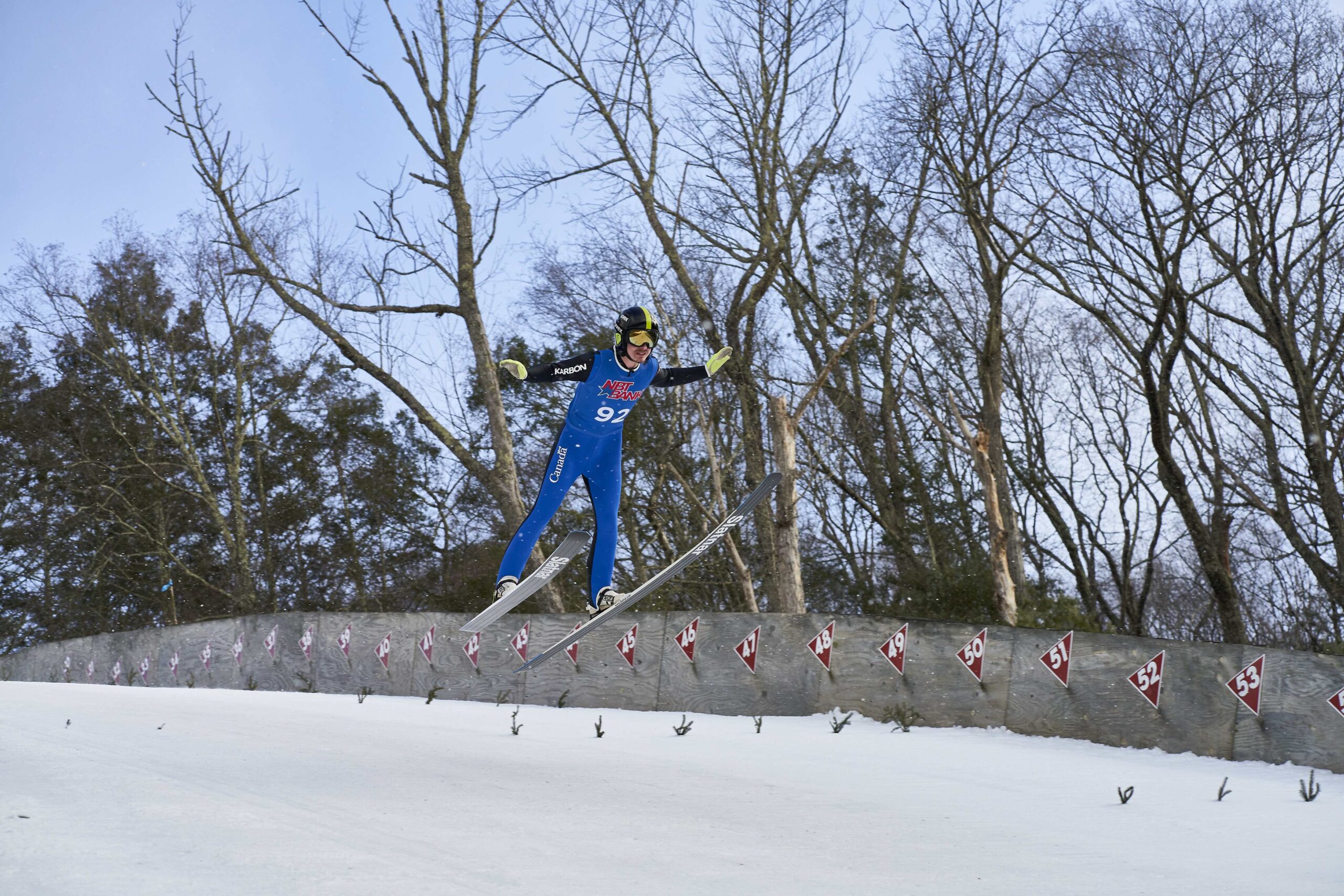
In February 2026, Salisbury will mark a remarkable milestone, as Jumpfest celebrates its 100th
anniversary, honoring a century of ski jumping tradition at historic Satre Hill.
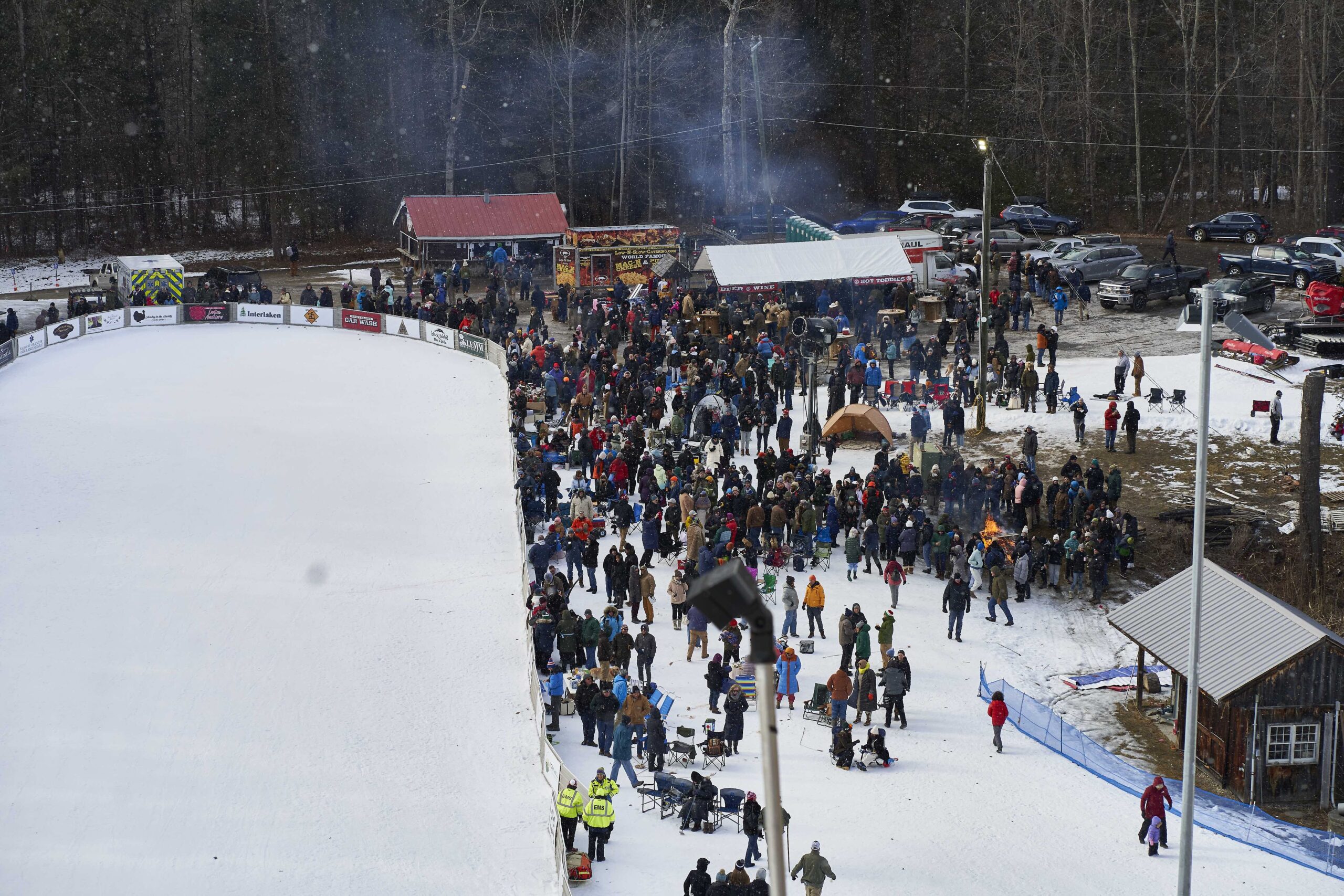
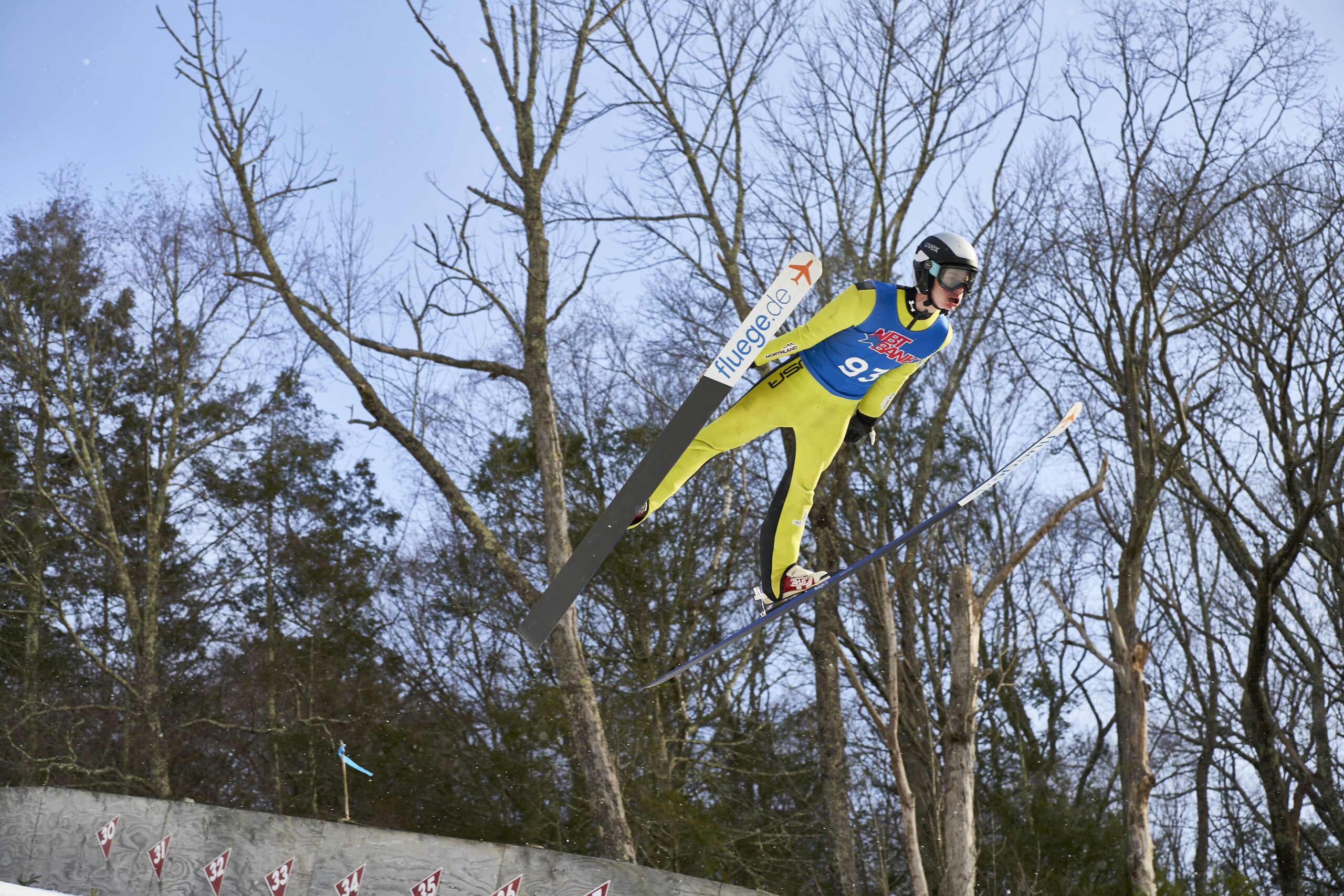
In February 2026, Salisbury will mark a remarkable milestone, as Jumpfest celebrates its 100th anniversary, honoring a century of ski jumping tradition at historic Satre Hill. Hosted by the Salisbury Winter Sports Association, Jumpfest is one of the oldest continuously running ski jumping competitions in the United States, and a cornerstone of winter life in the Northwest Corner.
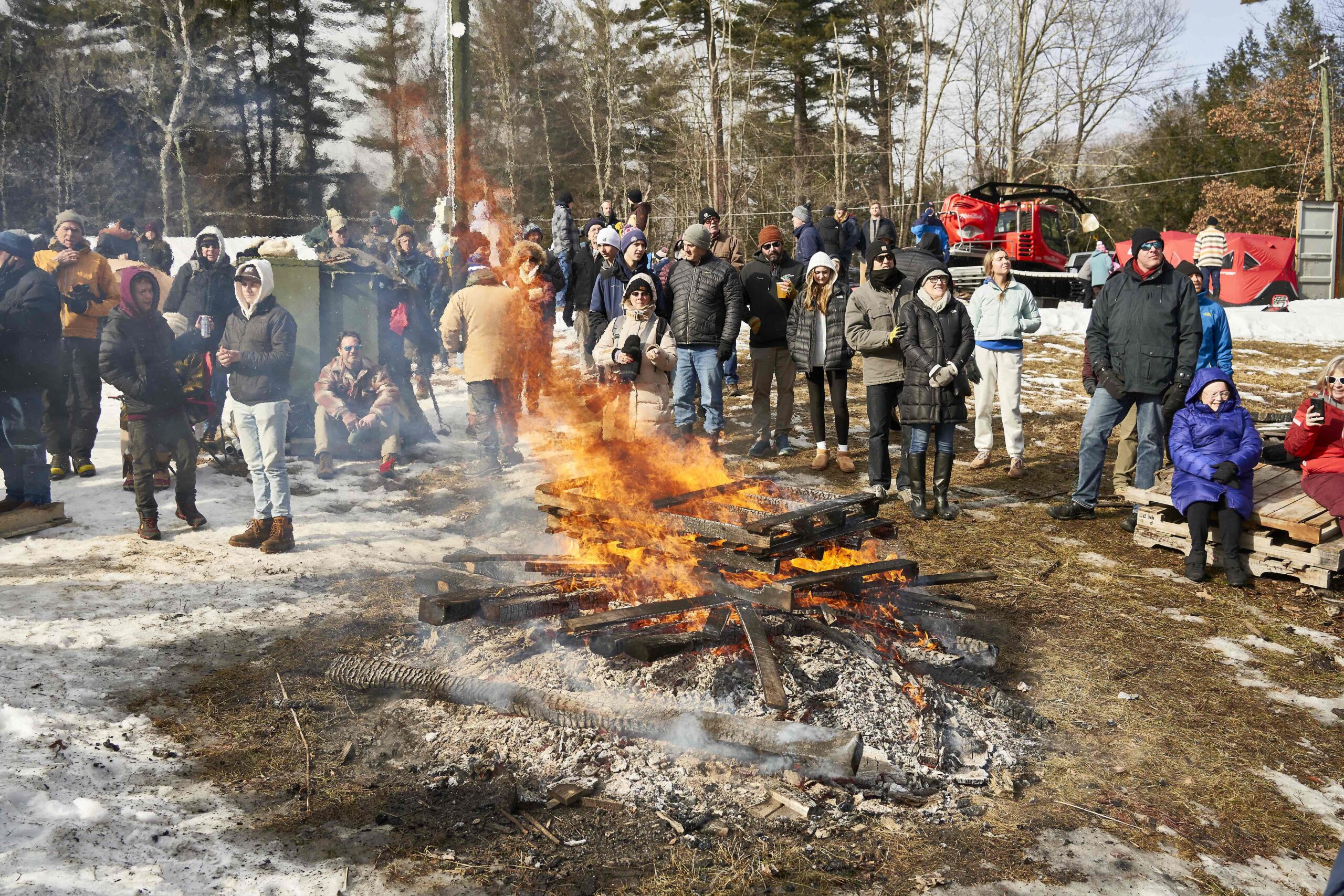
The centennial Jumpfest weekend, scheduled for February 6 to 8, will feature the thrilling ski jumping competitions that spectators have come to love, along with longtime crowd favorites such as the Human Dog Sled Race and family-friendly festivities throughout the weekend. Athletes of all ages and abilities will take flight, continuing a legacy that began in 1926. Looking ahead, Jumpfest’s 100th year also signals meaningful investment in the future of the sport. Significant improvements are underway at Satre Hill, including the construction of a new K36 intermediate jump, upgrades to snowmaking capabilities, and enhanced lighting. These improvements will strengthen training opportunities for young athletes, improve safety, and elevate the overall spectator experience during events.\ Proceeds from Jumpfest support youth ski jumping and Nordic programs, ensuring the next generation can carry this tradition forward. As Salisbury celebrates 100 years of winter sports history, Jumpfest remains both a tribute to the past and a bold leap into the future.
—jumpfest.org
A Century of Tobogganing on the Snowy Streets of Litchfield Is Recalled in a Postcard Photo and More
By Gavi Klein
Photo credit: Courtesy of Litchfield Historical Society
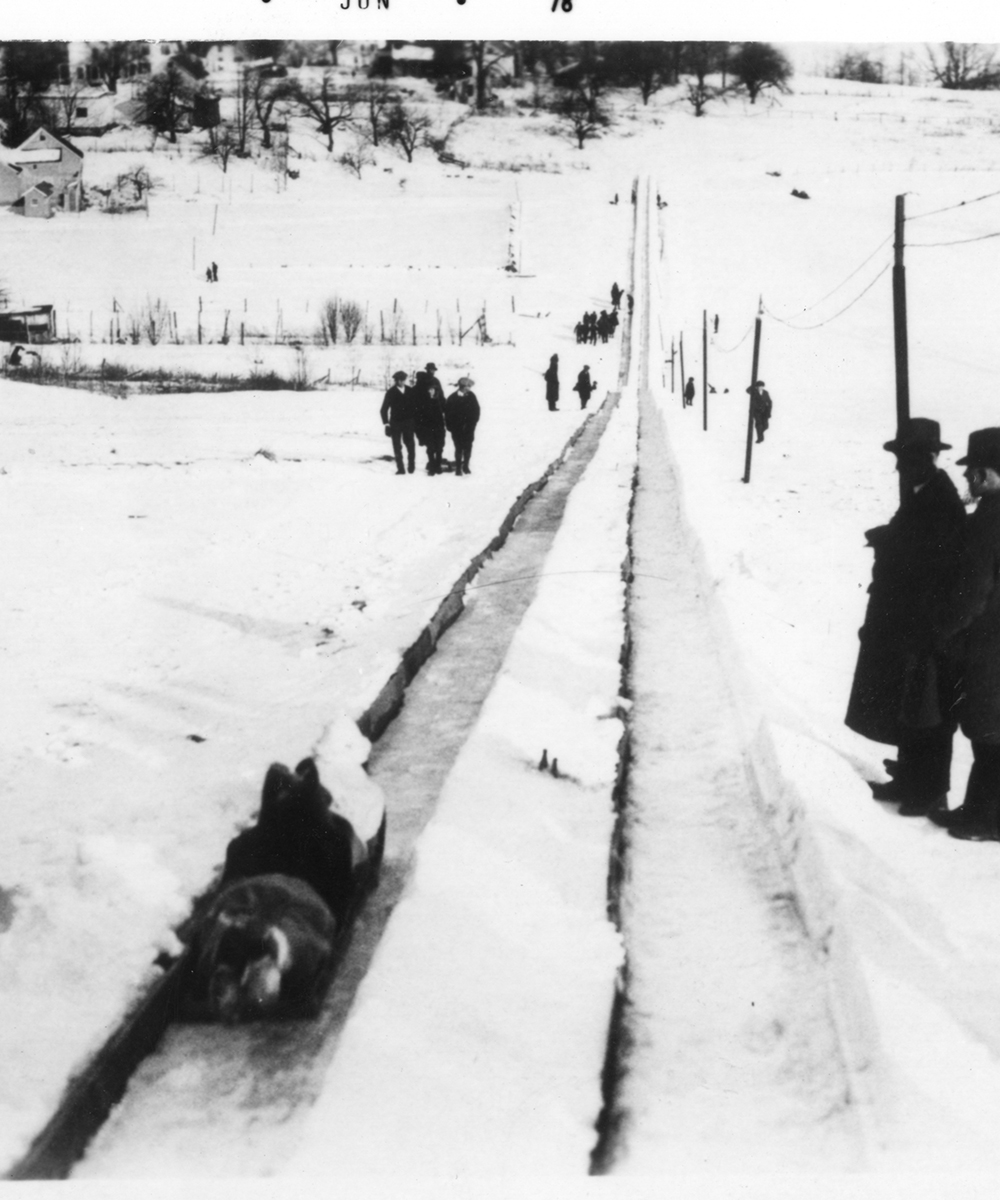
Snow days might be a thing of the past, but hopefully Litchfield’s legacy of tobogganing down snowy streets is not. Our first big snow of the year harkens back to the days of sledding down town streets in chilly glee—this 20th century postcard photograph, depicting Litchfielders tobogganing down East Street behind St. Michael’s church, represents a nostalgia that born-and-bred Litchfield folks know well. Long-time residents recall tobogganing down Litchfield streets back in the ‘50s, ‘60s and ‘70s after massive snow storms—but the above postcard photo was likely taken sometime in the ‘20s, as it is addressed in 1924. However, even before that, tobogganing has been a wintertime Litchfield tradition on those white-blanket days. The Toboggan Club was founded in 1886, leading to the building of a massive slide down Prospect Street. The club was so popular that young people as far as Woodbury were known to come to Litchfield for a spin. Even before that, in 1799 Jane Watkinson, a Litchfield resident, recalls to her brother in a letter (currently at the Litchfield Historical Society), “Hannah, and one of our boarders and myself went yesterday after school and bespoke a sledge to slide down hill on, and I promise myself much pleasure this evening from that amusement.” Here’s hoping that this year we’ll get enough snow to bring back this cherished Litchfield tradition!
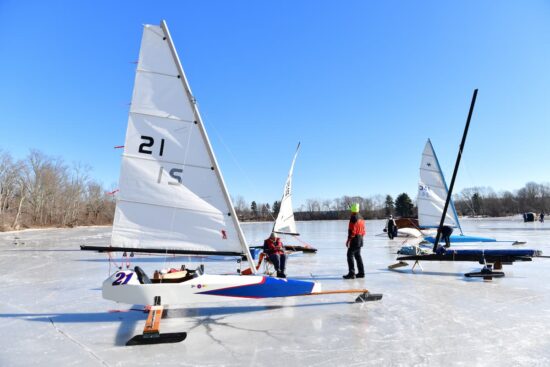
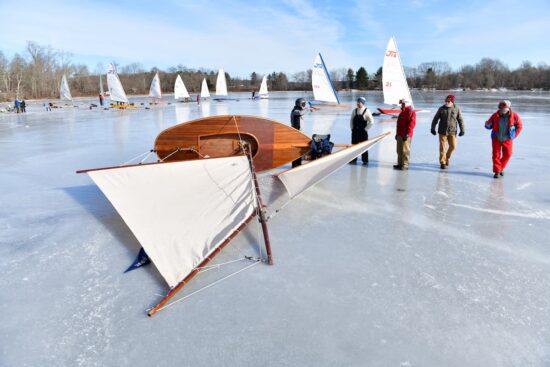
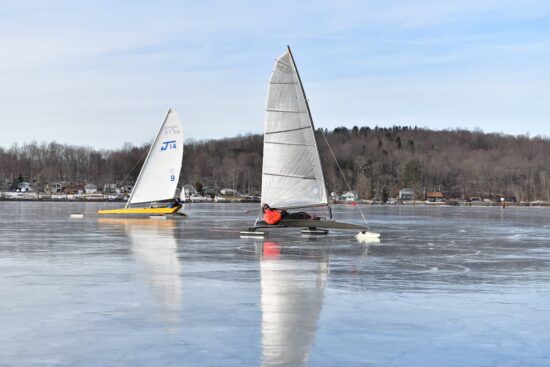
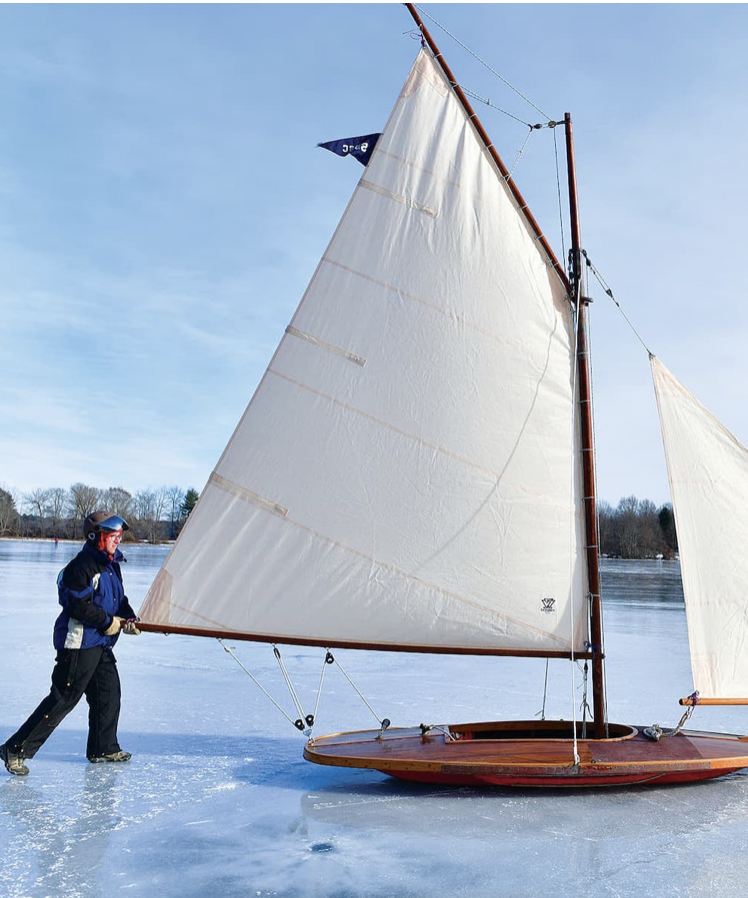
Its size, shallow depth, and strong breezes have made Bantam Lake one of the best ice boating lakes in the Northeast.
A Mecca for Ice Boaters
By Joseph Montebello
On a frigid January day, I was introduced to ice yachts. While I had been assigned to write a piece about the sport of iceboating, my knowledge of it was minimal, to say the least. After discovering the archives of the Connecticut Ice Yacht Association at the Litchfield Historical Society I learned its history and obtained a membership list. Reading about the sport and watching boaters in action are decidedly different experiences. Thanks to member Ted Bent, I had the chance to meet some of the club’s participants and watch them in action.
Philip Dutton
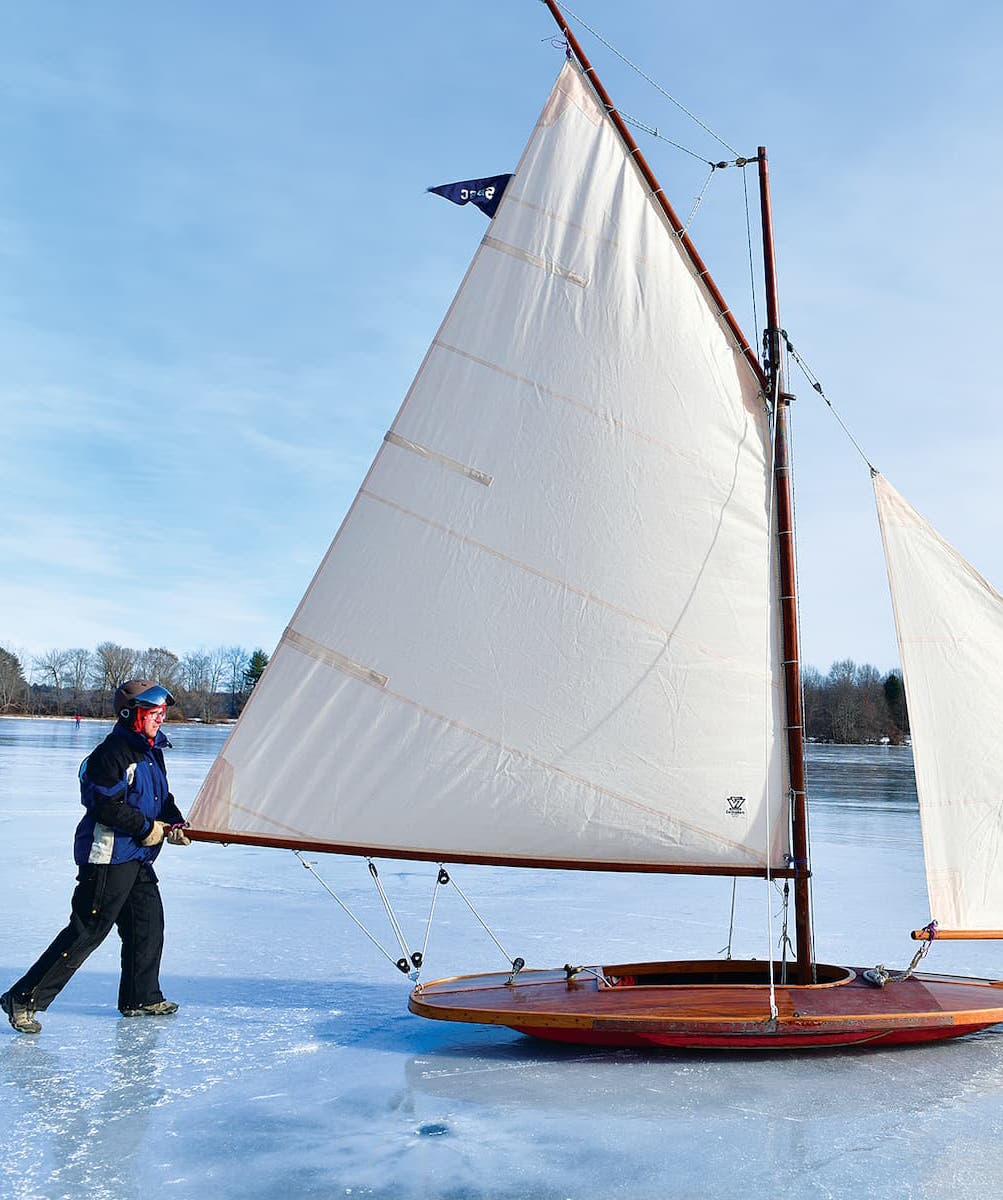
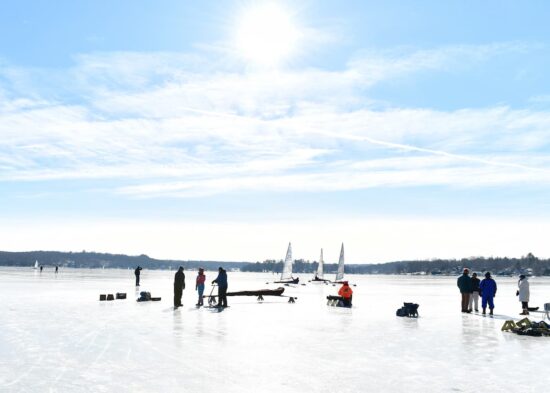
Sailing the lake’s crystal clear waters in the summer is the perfect escape. But winter brings a whole new dimension. Its size, shallow depth, and strong breezes have made Bantam Lake one of the best ice boating lakes in the Northeast. Since its inception in 1939 the Connecticut Ice Yacht Association (renamed a “Club” in 1941) has attracted both locals and enthusiasts from outlying states to experience the joys of winter yachting.
Philip Dutton
By 1941 there were 37 active members sailing on Bantam Lake. Today the membership totals 54 and even though women were accepted in 1947, there is only one honorary female member.
Philip Dutton
Boat design varied from those built by professional makers such as Mead Glider Company in Chicago, Illinois, and the Palmer Boat Company in Fontana, Wisconsin, to homemade versions. Alexander Bryan, an early member, designed and built eight Tumbleweeds, known as T-Boats, in his garage at a cost of $110.00. In 1937 a build-at-home design called the International DN became available and has become the most popular iceboat in the world.
Philip Dutton
“Bantam Lake is one of the best sailing lakes in the Northeast and people come from all over to sail here,” says Commodore Tony Bosco. “The snow melts just enough during the day and then freezes over at night. The crust remains until the following afternoon. The process keeps repeating itself so we can ice boat here all winter.”
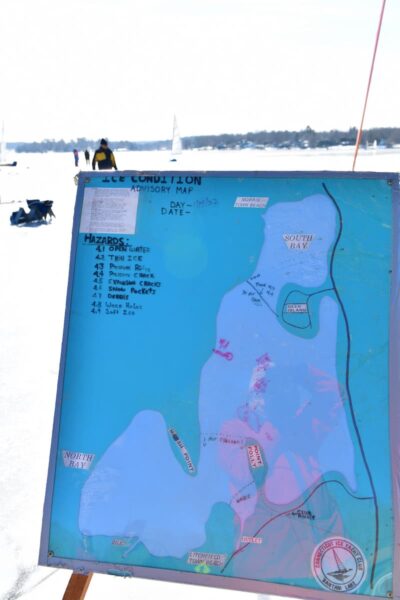
Joining Bosco to test the lake for safety are George Neyssen, Dave Danielson, and Owen Mehle. Dressed in several layers of warm clothing, wearing spiked hunter’s boots and armed with Eagle Claw ice safety picks, a whistle, a safety line, and a foot-long drill to determine the depth of the ice. It has to be at least four inches to be sailable.
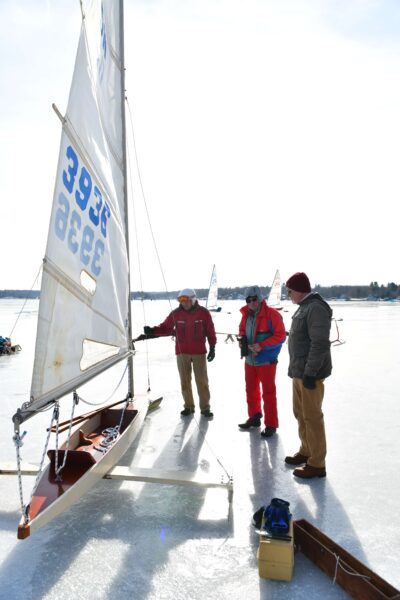
“We set up races,” explains Bent. “I have a DN. The plank goes horizontally, like a tricycle. There is a runner, similar to an ice skate blade, on each side and in the front. That blade is used to turn the pedals. If the wind is blowing 20 miles per hour, you can go 40 because there is no resistance holding the boat in the water.”
Philip Dutton
The ice level is perfect and the men are ready to start their adventure.
“It’s the competition and the camaraderie that get us revved up,” says Bosco. “You’re on the starting line and pushing off, racing at 50 to 60 miles an hour. You can’t beat that feeling.”
Bundle up in layers and head outdoors to enjoy all the fun outdoor activities that Litchfield County has to offer.
Litchfield County is your go-to for winter fun—ski, skate, sled, or sleigh!
The winters in Litchfield County may be cold but they can also be fun. Make the most of it! Bundle up in layers and head outdoors to enjoy all the fun outdoor activities that Litchfield County has to offer. From downhill skiing and snowboarding, to ice skating and sledding, from taking a sleigh ride, to tasting the naturally sweet goodness of maple sugar, we’ve made a list of outdoor activities for you to enjoy this winter. And for more winter fun, make sure to check out our list of 30 Things to do in Litchfield County this Winter.
Down-Hill Skiing, Snowboarding, and Tubing
Mohawk Mountain
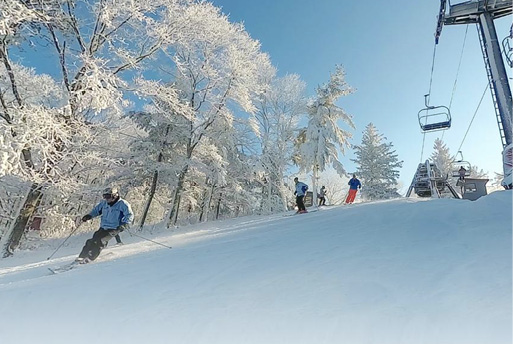
Mohawk Mountain is the state’s oldest and largest ski area. The family owned and operated resort offers down-hill skiing and snow boarding, with 19 open ski trails, 5 ski lifts and snowmaking coverage on 95 percent of the mountain. Daily night skiing (except on Sundays).
Ski Sundown
Fifteen trails serviced by 5 lifts with one hundred percent snowmaking coverage offering varied terrain choices for skiers and snowboarders of all abilities. Day and night skiing and snowboarding from early December through late March. Full service rental and repair shop, snowsports shop, modern and spacious lodge with two self-service food courts, apres ski lounge and mountain view decks. Showsports School offers group and private lessons for ages 4 and up.
Black Rock Park
439-acre Black Rock offers a variety of outdoor activities. Steep, wooded ledges covered with pine, hemlock and oak provide the setting for Black Rock Pond. Winter activities include cross-country skiing and ice skating.
Route 6 Thomaston 860.677.1819
Burr Pond State Park
Burr Pond is the 343-acre site of Borden’s first condensed milk factory in the U.S. A scenic path encircles the 88-acre pond contained in the Park. Winter activities include cross-country skiing and ice skating.
Route 8 Torrington 860.482.1817
Dennis Hill
Dennis Hill, a 240 acre estate. A unique summit pavilion, located at an elevation of 1627 feet, is a popular attraction. Winter activities include cross-country skiing.
Route 272 south Norfolk
Drady Rink
Open weekday mornings for skating: Mondays, Tuesdays and Thursdays from 9 a.m. to 1 p.m., Wednesdays from 9 to 10:15 a.m., and Fridays from 9 to 11:15 a.m. through February. The fee is $5 per skater per session.
Canterbury School 101 Aspetuck Avenue New Milford
Hotchkiss School Rinks
Ice skating.
11 Interlaken Road Lakeville
Housatonic Meadows State Park
Located in the rock-strewn valley of the Housatonic River amid the rugged hills of the Northwestern uplands, the 451-acre Housatonic Meadows is an ideal setting. Limited cross-country skiing.
Route 7 Sharon 860.927.3238
John A. Minetto State Park
This 678-acre Park was once the location of the first house constructed in the Town of Winsted. The rolling, open land was formerly known as Hall Meadow after the adjacent Hall Brook. Winter activities include cross-country skiing and ice skating.
Route 272 Torrington
Linen Rink
Ice skating. Open to the public for family skates on Sundays from 4:45 to 7 p.m.
Gunnery School 99 Green Hill Road Washington
Macedonia Brook State Park
Macedonia Brook became the property of the State in 1918 through a gift from the White Memorial Foundation in Litchfield. Two peaks within the Park are near 1,400 feet in elevation and offer outstanding views of the Catskills and Taconic mountains. Winter activities include cross-country skiing.
159 Macedonia Brook Road Kent 860.927.3238
Mohawk Mountain State Forest
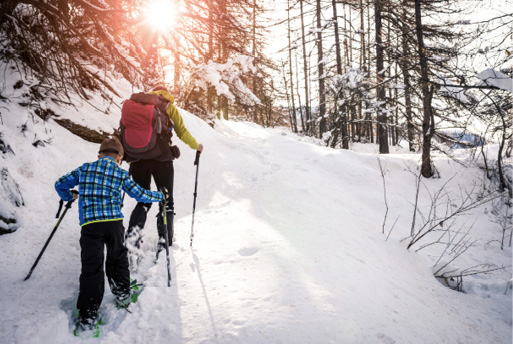
With rugged hills, deep forests, panoramic vistas and 30 miles of trails, Mohawk Mountain State Forest in Cornwall is the ideal place for snowshoeing or cross-country skiing. Explore the Mohawk Trail, once part of the Appalachian Trail. The trail leads to Mohawk Tower, which offers a breathtaking view of the rolling Litchfield Hills. The cross-country skiing trail is another option that offers a sampling of the mountain’s diverse landscape. Those in need of snowshoes can rent them at the nearby Housatonic River Outfitters, Inc. in Cornwall Bridge.
Mt. Tom State Park
Mt. Tom is one of the oldest parks in the state park system; it is named for the mountain within its boundaries. There is a stone tower on top of the mountain which is a favored destination among hikers. The summit of Mt. Tom is 1325 feet above sea level, 125 feet higher than its Massachusetts counterpart. The tower trail is about a mile long and rises some 500 feet. Winter activities include ice skating.
Rte. 202 Litchfield 860.424.3200
Nadal Rink
Ice skating.
Kent School Macedonia Road Kent
Norfolk Ice Skating Rink
Ice Skating.
23 Mountain Road Norfolk
Peoples State Forest
Along the Farmington River, this forest features hiking and cross-country ski trails. There are several tranquil trails here, including the Agnes Bowen Trail (Orange) which is a traditional 1930’s ski trail. Distance – 2.5 miles.
East River Road Barkhamsted 860.379.2469
Pratt Nature Center
A year-round resource where you can spend time enjoying the joys of nature in a carefully maintained environment. Miles of trails for snowshoeing are perfect for a family outing.
163 Papermill Road New Milford 860.355.3137
Lufkin Rink
They offer three family skates to the public each year. They also offer lessons to students and their siblings who wish to learn to glide across the ice.
Rumsey Hall 201 Romford Road Washington
Salisbury School Rink
Ice skating.
251 Canaan Road Salisbury
Topsmead
Topsmead is an English tudor mansion set on 511 acres. During the summer the house is open for tours. The grounds are open year-round and feature hiking, sledding, and cross country skiing.
Buell Road Litchfield 860.567.5694
White Memorial Foundation
The White Memorial has miles of trails for cross-country skiing and snowshoeing. It is located in Litchfield on 4,000 acres, free and open to the public.
Yes, Ice boating. There are ice yachts and people who race around them when it’s safe on Bantam Lake. Read more about it here.
You will also find many people ice fishing on Bantam Lake. Before dropping your line into the icy waters, you must get a permit. Permits may be purchased at local town halls, tackle shops, or through the Department of Energy and Environmental Protection’s store.
Bantam Lake
At 947 acres, Bantam Lake sits as the largest natural body of water in the State of Connecticut. It is fed by Bantam River and Whittlesey Brook in the western part of the state. Fishing is excellent and there are more than an average of 20 annual bass fishing tournaments per year. Ice fishing is very popular here.
Bantam Lake, Morris
Lake Waramaug
Bass enthusiasts can head to Lake Waramaug in Kent, rated one of the state’s “Top Winter Bass Lakes” by New England Game & Fish magazine. Covering more than 656 acres, it is Connecticut’s second-largest natural lake. During the winter season, anglers can pursue largemouth and smallmouth bass, brown trout, chain pickerel and yellow perch.
Lake Waramaug, New Preston
The 25-acre property—like a Currier and Ives scene, with two ponds—has been in his family for five generations. Ken, a farrier, began running sleigh rides in 1972; they do more than 200 in a good season.
Loon Meadow Farm
Offerings include a two-passenger antique surrey sleigh (for couples) and the larger 10-passenger sleigh pulled by two horses. Winter sleigh rides are offered in antique sleighs complete with cozy lap robes, jingling sleigh bells and hot, mulled cider. Special accommodations for groups can be arranged.
Interlaken Inn
Interlaken Inn’s “Sleigh Ride Package” is available through most of the winter, and includes the sleigh ride, dinner, an overnight room and breakfast the next morning.
Interlaken Inn Resort and Conference Center 860.435.9878 800.222.2909 www.interlakeninn.com
Here in the Northwest Corner we are fortunate to have a myriad of things to do year-round. Even during the cold, dark days of winter Litchfield County offers up plenty of activities for everyone. Whether you’re a winter sport enthusiast or prefer to stay indoors on blustery days, check out this list for inspiration.
Even during the cold, dark days of winter Litchfield County offers up plenty of activities for everyone. Whether you’re a winter sport enthusiast or prefer to stay indoors on blustery days, check out this list of things to do for inspiration. And for more fun check out our list of sugar houses to visit for some home-made local maple syrup.
3. Go ice fishing at one of the many lakes or ponds. (Bantam Lake, Mount Tom Pond, Burr Pond and Saltwater Pond, Mohawk Pond, East Twin Lake, etc.) But please read about ice safety before you go.
5. Visit the Sharon Audubon Society in Sharon where you can explore their visitor’s center, learn about their wildlife rehabilitation clinic, and participate in programs and events.
9. Sample some delicious hard cider and purchase some local food stuffs at Hogan’s Cider Mill in Harwinton, which has been making cider since 1912. The second floor of their barn is also filled with quirky antiques to explore (not for purchase), including a phone booth from the 1800s.
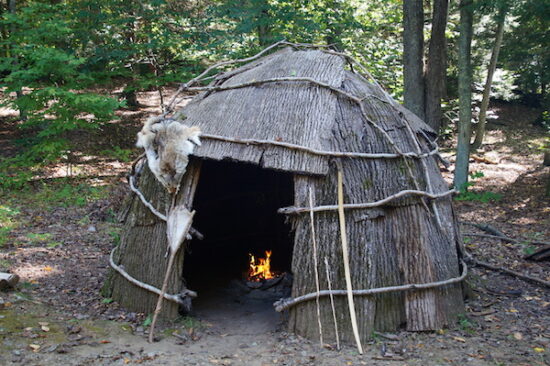
15. Learn about Native American life in the Washington area during the 16th century at The Institute for American Indian Studies where you can visit a life-size replica of an Algonquin village with wigwams and longhouses constructed using traditional techniques. Try out their award-winning Wigwam Escape room.
20. As soon as Bantam Lake freezes with ice thick enough for sailing, enjoy the ice yachts flying across the surface on weekends and also some weekdays.
Photo by Philip Dutton
21. Check out your local library to find out what programs, events, and talks they are offering this winter.
25. Peruse Whiting Mills in Winsted. These old former mill buildings now house an eclectic mix of artists, craftspeople, retail shops, and small manufacturing companies who all offer their wares for sale.
Our Litchfield Magazine family had a lovely evening at Spring Hill Vineyards last weekend to celebrate the wonderful businesses and individuals featured in our Design and Holiday Issues.
Our Litchfield Magazine family had a lovely evening at Spring Hill Vineyards last weekend to celebrate the wonderful businesses and individuals featured in our Design and Holiday Issues. Big thanks to By Tastings, Litchfield Distillery, J. McLaughlin, Saturn Press, Philip Gorrivan, Spring Hill Vineyards, Mileen Zarin Events, Litchfield Hills Supply, and Magician Belinda Sinclair who made the night literally magical.
Litchfield County artisans, experts, and shops provide unique, high-quality gifts and services to make your holidays magical.
If your holiday season starts off at a steady, spirited pace, but turns into a dash for the finish, you’re not alone. There’s a LOT to do, not the least of which is finding ideal gifts for everyone on your list. Take heart. Artisans, procurers, and professionals across Litchfield County are ready to lighten your load with their unique, top-quality wares and services…keeping your Christmas, Hanukkah, and Kwanzaa celebrations magical from now until the new year!
The Holiday Spirit
Year after year, Litchfield Distillery makes it so easy to give the spirit lover in your life something to look forward to. For 2025, their Founders’ Reserve release showcases an exquisite 8-year bourbon whiskey crafted from 100% Connecticut-grown grains and bottled at 100 proof. Aged to perfection, this rich, full-bodied bourbon reveals layers of caramel, butterscotch, and a hint of cinnamon on the finish — could those flavors be more apropos? It’s even ready for gifting in a striking, foil-stamped holiday gift box. $74.95
Litchfield Distillery, 569 Bantam Road, Litchfield, 860-361-6503 —LitchfieldDistillery.com
Mindful Merrymaking
What’s worth more than good health? This holiday season, you can give the gift of wellness with a gift card to LPIH, a boutique studio featuring Pilates, yoga, health coaching, and more. Help your loved ones start the new year feeling stronger and more centered … it’s the perfect way to show you care. Gift card purchases over $150 include a free pair of grip socks (hello, stocking stuffer!); gift card purchases over $500 receive $50 bonus through 12/31/25. Litchfield Pilates & Integrative Health, 2 Green Hill Road, Washington Depot, 860-318-6283
—Litchfieldpilatesandintegrativehealth.com
The Gift of Sanctuary
A Spaliday in the Hills is the perfect gift to pamper your loved one this giving season. This limited-edition holiday spa package features a 50-Minute CauseMedic Botanical Pain Relief Massage, OSEA Organic Spa Facial, Spa Pedicure and Spa Manicure. They’ll unwind in the serene atmosphere of The Spa at Litchfield Hills — you’ll be the reason they emerge renewed and glowing. Gift cards can be purchased online, by phone, or in the boutique. In-store pickup or shipping available. $435
The Spa at Litchfield Hills, 407A Bantam Rd., Litchfield, 860-567-8575
—Litchfield-spa.com
WHIMSICAL AND SOPHISTICATED GLASS AND GOLD HOUSEWARES ARE THE PERFECT GIFT FOR YOUR HOSTESS—OR YOURSELF
The New Preston shop of the interior design team Eleish van Breems overflows with elegant items for the home—but the delights don’t stop there. From large to small, from silly to sublime, from advent calendars to ornaments to a menagerie of tiny felted animals, everything you need for the holidays is here. 1 and 9) Wild Collection Murano glass tumblers in coffee and cream ($175) 2) large green carafe ($225) 3) Natur Porcelain dinnerware from Sweden, including dinner ($65) and dessert plates ($50), a bread plate ($60), and a round one-handle bowl ($75) 4) Ebba large vase in amber ($575) 5 and 6) Elegante candlesticks in forest green with white rims ($975 for the tall candlestick, $825 for the low version) 7 and 12) set of three Kin brass candleholders ($80) 8) Lina blue dinner plate ($95) 10) Augarten x Eleish van Breems porcelain and gold champagne cup in light blue ($235) 11) Ebba large vase in green ($575) 13) Bubbles tealights in green and gray ($40 each). ELEISH VAN BREEMS HOME, 11 Main St., New Preston, 860-868-0066.
—evbantiques.com
To Your Health
Cheers to everyone on your list feeling their best this year! At Core Luxe, Pilates is for all people — they believe every BODY can benefit. Perfect for fitness lovers or those new to Pilates, their packages offer tailored reformer classes designed to strengthen the body, improve balance, and enhance the mind-body connection. Choose from group or private sessions in their serene boutique studio for a truly transformative experience. $125 (New Clients: 3 Classes) or $350 (Existing Clients: 12 Classes) through 12/31/25. Call to purchase.
Core Luxe Pilates, 710B Bantam Road, Suite B, Bantam, 860-477- LUXE (5893)
— Coreluxepilates.com
Beauty of the Season
A trip to Byrde + the b is always a treat, but this season it’s all the more special because of their Environ Triawave Facial. This state-of-the-art offering combines three technologies to lift and tone facial muscles, while deeply infusing vital nutrients into the skin, improving fine lines, wrinkles, uneven tone and sagging skin without downtime. For the skincare lover in your life, what could make a more happy holiday than that? Byrde + the b, 43 West Street, Litchfield, 860-619-0422
—Byrdeandtheb.com
Gifts of Wellness
This season, share the joy of health and balance with those you love – or treat yourself. Charym, Litchfield’s top yoga and movement studio, offers a wide variety of yoga styles, Pilates, dance, meditation, sound baths, and more. Gift certificates, class packages, and memberships make perfect presents, or you can shop their curated selection of yoga mats, natural skincare, and essential oils. Another option — hosting a private wellness retreat for family and friends! Celebrate the season with the most meaningful gift — well-being.
Charym Yoga & Movement Studio, 174 West Street, Litchfield, 860-245-8586
—Charym.com
Sparkling Bright
Move over gold, frankincense, and myrrh. Lumeniri in New Milford offers cultivated luxury for the modern jewelry gift-giver. The first of three stunners this holiday season is a striking blue east-west set marquise lab-grown diamond — perfect for a pinky, cocktail or modern engagement ring ($2,195). The second is a soulful, symbolic evil eye medallion featuring a blue lab-grown diamond ($2,695). Finally, the graduated Riviera diamond necklace is a refined and fluid, non-tennis take on timeless luxury ($3,195). All three are set in 14K gold, and custom designs are always welcome.
Lumeniri, 7 Kent Road, New Milford, 312-320-3797
—Lumeniri.com
What a Gem
Add some sparkle for the holidays and all days! These lustrous French, multi-gem earrings are hand-wrought in 18-karat yellow gold with rubies, emeralds, and sapphires. Dating to 1960, these mid-20th century stunners are something she can carry off at a cocktail party, or with jeans and a black turtleneck. Price upon request. If it’s not quite the pair you had in mind, peruse their extensive collection of one-of-a-kind pieces from every period at their New Preston shop. Holiday hours Wednesday – Sunday, 11 – 5.
Hays Worthington, 13 East Shore Road, New Preston, 860-619-0714
—Haysworthington.com
Moved by the Thought
This holiday, surprise your loved ones with the magic of MOMIX at the Warner Theatre in Torrington. The dance-illusionist company’s live performances create unforgettable moments, spark conversation, and bring everyone closer together. Their newest show ‘Botanica, Season 2’ plunges audiences into a visual kaleidoscope, celebrating human form and the imagery and magic of the four seasons. For 45 years, Washington-based MOMIX has brought beauty and wonder to stages worldwide…creating memories that last long after the curtain falls! $45-75, February 21 & 22
MOMIX, P.O. BOX 1035 / 35 BELL HILL ROAD, Washington, CT, 860-868-7454
—Momix.com
Elizabeth Gilbert reflects on her childhood, Christmas tree farm, and creative roots in Litchfield, Connecticut.
By Wendy Carlson
Photograph by Deborah Lopez
Ever since grammar school, author Elizabeth Gilbert has been writing. By middle school, she was mimeographing poems in the principal’s office and handing them out to classmates. At Litchfield High School (Class of 1987), she was already sending short stories to The New Yorker, hoping for publication.
The author of nine acclaimed works of fiction and nonfiction—including the best-selling memoir Eat, Pray, Love, which catapulted her to international fame, and became a film starring Julia Roberts—Gilbert returned to the Warner Theatre in Torrington this fall to discuss her latest memoir, All the Way to the River. The riveting story centers on the love of her life: a queer, recovering-addict hairdresser from Queens, and how her death led to Gilbert’s greatest awakening.
Litchfield Magazine spoke with Gilbert about how growing up on a Christmas tree farm in Litchfield County helped shape her lifelong pursuit of happiness and fulfillment.
First, what was it like during the holiday season growing up on Bees, Fleas & Trees, the Christmas tree farm your parents, John and Carole Gilbert, own?
I’ve often said that selling Christmas trees is like selling ice cream (and I’ve done both, so I really know what I’m talking about here!) in that people are always cheerful and happy to buy these products. I loved December on the Christmas tree farm—the physical labor of cutting down and bailing trees, the joy of little kids running around the farm, and the endless hot chocolate and doughnuts. My parents really had (and still have) a talent for making people feel warm and welcome, and over the decades my friends from high school, college, and beyond all loved working on the farm. It’s an exhausting but ultimately really satisfying time of the year.
What was a typical Christmas like for your family—anything that might surprise people?
The joke (not really a joke) that we always tell in my family is that we always had the worst tree for us! People assume that our own Christmas tree must have been the most lush and beautiful one, but nothing could be further from the truth. My dad wasn’t going to waste a perfectly profitable tree on his own family, and anyway we were all pretty tired of Christmas by the time the actual holiday rolled around. So we always got whatever un-sellable tree was left on the lot. “The cobbler’s children have no shoes,” is what my Dad always used to say!
How did farm life teach you independence and spark your creativity?
What I learned more than anything else is that you are allowed to make your own thing in life. You are allowed to have passions and curiosities that exist outside of the “normal” realm of day-to-day life. My mom was a nurse and my dad was an engineer, but that’s just what they did to make a living; everything on the farm was what they did for love. Gardening, sewing, taking care of bees and chickens and goats, growing trees—these were just some of their sideline artistic projects. So what I grew up seeing were two really important lessons about how to be an artist, even though I don’t think either of my parents would have called themselves “artists.” I saw that you should always have a day job that you can rely upon to be financially independent, AND you get to pour all your love and passion into your heart’s true calling, which is your own business, doesn’t need to make sense to anyone else, and will fulfill your spirit. This is fantastic training for the arts. So I followed in my parents’ footsteps—not by becoming a farmer or a master gardener, but by moving to New York, getting a day job, and working on my writing in the evenings and on the weekends. They modeled that dual sense of responsibility and freedom beautifully for me.
Who encouraged and inspired you as a young writer growing up in Litchfield?
I was writing my whole life—as soon as I could spell! (okay, to be fair, I still can’t really spell.) I remember writing poetry in grammar school, plays in middle school, and short fiction in high school. I had a slew of teachers who were so encouraging—but Bill Bucklin and Sandie Carpenter [Litchfield High School] were the most generous with their praise, guidance, and time. The librarians at the Oliver Wolcott Library in Litchfield were also like a team of loving literary aunties to me—and they gave me the run of the library, which was so kind. I consider myself so lucky to be the product of a really good public education system and really good public libraries. As the years have gone by, I have only appreciated more the education that Litchfield offered to me, in so many ways.
What places in Litchfield feel most like home to you today?
While much of Litchfield has changed, the most special part of it to me remains the same—or is even improved. The woods at the White Memorial Foundation were always a haven of silence and beauty for me growing up, and I still love to go wandering those trails, which are even nicer now and better kept up than they were 40 years ago. There is something about the Connecticut woods that isn’t like anything else for me, that mix of sun and shade; the smell of pine and ferns and even skunk cabbage; the moss and the outcroppings of granite. Being in those woods brings me right back to the best memories of my childhood, where, even as a restless teenager, I knew that this was a beautiful and special place. So my favorite thing when I come is to put on some hiking boots and go straight to the woods. It clears my spirit the same as it ever did. Of course there are more bears now than there used to be, but that just makes life more exciting!
Readers eager to join Elizabeth Gilbert on her journey of love, loss, and self-discovery can seek out her memoir, All the Way to the River: Love, Loss, and Liberation. Bees, Fleas & Trees is at 551 S. Plains Road, Litchfield.
STAY IN THE KNOW
Your weekly guide to can't-miss events, hidden gems, and local favorites in Litchfield County.
Sign up now for curated things to do, eat, and explore—delivered every week.
It’s free. It’s local. It’s essential.