
Your guide to the heart of Litchfield County:
Discover local stories, hidden gems, and must-know events.

Olson Twombly: Timeless Layered Interiors

Olson Twombly creates warm, eclectic, and timeless interiors blending antiques, textiles, and modern design for clients nationwide.

Photographs by Matt Kisiday

Olson Twombly is a husband-and-husband design firm rooted in both Litchfield County and Nantucket, with clients nationwide. Known for a warm, layered, and eclectic approach, their work blends antiques, textiles, vintage finds, and modern elements. Their philosophy centers on creating timeless spaces that reflect each client’s individuality and story.

What inspires your work?
We’re inspired by travel—particularly throughout Europe and North America—as well as New England history, our homes on Nantucket and in Litchfield County, and the artisans, textile designers, and furniture makers we’ve been fortunate to collaborate with. Ultimately, the architecture, the location, and the client together inform our approach on every project.

Who is your ideal client?
Our ideal clients are homeowners with families who want their spaces to grow as their families do. They’re thoughtful, engaged, and open to a collaborative process that ensures their own personalities and tastes shine through in the finished design.

How would you describe your design philosophy or aesthetic?
Warm, layered, and eclectic. We have a deep appreciation for antiques, textiles, vintage and mid-century pieces, and modern architecture. We also design custom furniture to suit specific projects. Above all, our work is client-driven rather than dictated by a singular aesthetic.

What sets your business apart from others in the field?
Our backgrounds extend beyond interiors to include retail, clothing, furniture, and jewelry design. These experiences give us a broader creative lens, and allow us to approach interiors with a unique perspective.

Can you share a recent project that you’re especially proud of?
We recently completed our own home in the Connecticut River valley, which was a deeply personal project. It was both a challenge and a joy to bring our vision to life and then, ultimately, to pass it on to its next chapter.

How do you incorporate innovation, sustainability, or craftsmanship into your process?
We love mixing vintage pieces with modern design. This approach not only supports sustainability, but also allows us to highlight the work of craftspeople and artisans. We also create custom furnishings to reflect each client’s personal aesthetic.

What’s the most rewarding part of your work?
Seeing a project come to fruition and witnessing the joy on our clients’ faces. Some of the most meaningful moments are running into clients months or years later and hearing how our work has positively impacted their daily lives.

What trends are you seeing in design right now, and how are you responding to them?
We prefer to transcend trends, focusing instead on timeless elegance and classic design that endures.

What advice would you give someone considering hiring a designer?
Start early and embrace the process. Great design requires time, thought, and collaboration.

What’s next for your business?
We’re completing a spectacular penthouse with ocean views in Miami and a family home in San Francisco. —olsontwombly.com.

Washington Supply: Balanced Kitchen & Bath Design

Washington Supply creates functional, stylish kitchens and baths with personalized design, expert guidance, and lasting appeal.

At Washington Supply, design isn’t just about beauty—it’s about balance. The Kitchen and Bath Design team at Washington Supply focuses on creating spaces that are as functional as they are stylish, offering thoughtful design solutions that enhance everyday living without sacrificing comfort or cost.

Their clients range from architects and builders to designers and homeowners, all of whom appreciate the personalized approach and depth of expertise the team brings to each project. “Our goal is always to create spaces that are aesthetically pleasing, functional, and reasonably priced,” the team shares. “It’s not just about following trends—it’s about crafting spaces that work for the people who live in them.”

What sets Washington Supply apart is its comprehensive approach. As a fully operational building center, the business offers more than just cabinetry design. With deep experience in cabinetry, designer hardware, millwork, plumbing fixtures, paint, and outdoor living products, clients can find everything they need for a project under one roof. This holistic setup allows the design team to collaborate seamlessly with other divisions, ensuring that each project is cohesive from concept to completion.

A recent favorite project, they note, involved transforming an outdated kitchen into a modern, light-filled space that combined clean design with everyday practicality. “Taking an old, tired space and turning it into something beautiful and functional—that’s always the most rewarding part of what we do,” they explain.

As for current trends, the team is seeing a growing demand for modern, minimalist looks—clean lines, uncluttered layouts, and subtle sophistication. Another emerging favorite is the use of multi-finished hardware, where contrasting materials and tones add depth and character to even the simplest designs.Washington Supply stays ahead by continually updating its offerings to reflect these shifts while maintaining timeless design principles that ensure lasting appeal.

Looking ahead, Washington Supply is expanding its design showroom to include architectural hardware and millwork, alongside its existing displays of cabinetry, countertops, and cabinet hardware.This expansion will further strengthen the company’s ability to serve clients at every stage of a project—from inspiration to installation.

For anyone considering a design project, Washington Supply’s advice is simple: Work with professionals who listen, who understand your lifestyle, and who have the expertise to bring your vision to life. —washingtonsupply.com 2 Calhoun St., Washington Depot 860-868-7395

Ground Breakers CT: The Steiners’ Family-Built Dream Homes

Lee Steiner and his family turn raw land into stunning custom homes, blending expertise, vision, and hands-on craftsmanship in Kent.

Lee Steiner has me fantasizing about spending a few million dollars to build a house from scratch. I’m not saying I will, but I am very inspired to do so. You know, the way Chris Hemsworth inspires me to have his body, but then I eat an entire carrot cake.

We meet on a quintessential late-September morning at a blasted-out hilltop in Kent, one of two sites he’s shaping along the same private road. Standing beside a poured foundation with mountains of displaced earth around us, the 56-year-old paints a vivid picture of what’s yet to come for his clients: main house, garage, breezeway, westward views, gym, infinity pool. Lee’s so detailed, I can’t help but picture myself living here happily ever after. 

And then Lee ruins my fantasy by talking about things that make my head hurt. Gradients, frost lines, drainage, elevations, stuff that would confuse Russell Crowe’s character in A Beautiful Mind. I try to nod along like I’m some sort of off-duty environmental engineer, but the tiny black flies aren’t exactly helping me look intelligent. They dive-bomb my corneas, seemingly intent upon entering my cranium. I swat them away as Lee and his chinstrap-bearded sons, Riley and Zach, regard my flailing with faint smirks.

“I walk onto raw land, and it’s a puzzle,” Lee says. “Everything’s already there; we just have to figure out the best use of it.”

As puzzles go, it does seem like a pretty fun one, situating a beautiful home in a beautiful part of the world. Maybe it’s even more exciting than completing Wordle in two moves. Maybe. I ask Lee if he ever turns off the part of his brain that calculates slope and soil. His sons laugh, and Lee tells me about a recent vacation in St. Martin. “We got this little condo right on the beach. I wake up early, around 5, and the seaweed’s terrible. There’s a guy out there on a backhoe. The way he’s doing this, I know it’ll take him all day! I also know Sharisse is going to want to go to the beach when she gets up. So I walk over to the guy and say, ‘Can I get in that? I know how to run it.’ He lets me. I finish the job in an hour.”

Later I speak with Sharisse by phone. She’s Lee’s wife, the fourth and final piece of Ground Breakers, the Steiners’ family business. (At 26 and 24, Riley and Zach are already partners, having operated heavy machinery since pre-puberty.) Sharisse handles project management and real estate deals mostly, having been a Realtor since high school. I ask her if her husband is as obsessive as he seems. “Oh, yeah. He’s always like that—when it comes to work,” she says. “He thrives on it. When it comes to excavating and building, he can juggle a hundred things at once.”

Does that extend to home life? “Let’s just say …household chores are not his forte.”

I leave the job site thoroughly impressed by the vision and the know-how, but mostly the family dynamic. While, personally, I can’t imagine spending that much time with anyone I’m related to genetically or legally, the Steiners really seem to enjoy it. And I’m happy for them. As I drive home I wonder whether I should cash out the ol’ 401(K) and build something from the ground up. I’ll make my decision tonight. Right after carrot cake. ——groundbreakersct.com

Agnes Gund: Art Patron and Philanthropist in Litchfield County

Agnes Gund, celebrated art patron and philanthropist, shaped the art world while leaving a lasting legacy in Litchfield County.

Agnes Gund (August 13, 1938 – September 18, 2025) was a distinguished art patron, a philanthropist, and an advocate, whose presence extended beyond New York into Litchfield County. In 1996, she purchased a 252-acre property in South Kent (known as Iron Mountain Farm), anchoring her connection to the region. Born in Cleveland into a family of wealth and civic engagement, she attended Miss Porter’s School in Farmington, Connecticut, and later earned a master’s in art history from Harvard. 

Her influence on the art world is profound. She served on MoMA’s International Council from 1967, joined its board in 1976, and was president of the board from 1991 to 2002. During and after her presidency, she helped guide MoMA’s $858 million expansion and its formal affiliation with PS1. She went on as president emerita and life trustee. 

Gund founded Studio in a School in 1977 in response to cuts to arts education public schools. In 2017, she sold Roy Lichtenstein’s Masterpiece to seed the Art for Justice Fund, committing $100 million to support criminal justice reform through art and advocacy. At her South Kent home, she integrated sculptures by Ellsworth Kelly, Richard Serra and others across the landscape. 

Agnes Gund’s life reflects the intersection of art, education, social justice, and place. Her legacy resonates in major cultural institutions across the country—and at home, here in Litchfield County.

Ellsworth Home: Timeless, Thoughtful Residential Design

Ellsworth Home creates timeless, soulful residences across New England, blending architecture, interiors, and site planning seamlessly.

Ellsworth Home is a residential design studio dedicated to creating homes with soul—whether restoring historic gems, reimagining spaces, or building from the ground up. Guided by restraint, natural palettes, and the ever-changing influence of light, their work balances beauty with atmosphere, crafting serene, timeless environments across New England and beyond.

For Jason VanWarren, founder of Ellsworth Home, good design isn’t about ornament—it’s about intention. “My ideal client is someone who’s opinionated but open,” Jason says. “Someone who wants their home to work hard and wear well. Most of all, someone who understands that good design isn’t decoration. I’m not a fan of pretense in design or designers.”

That belief informs a philosophy he describes as edited, livable, and timeless. VanWarren’s goal is to create spaces that balance utility with feeling. “If a room makes you pause, breathe deeper, or smile without knowing why, we’ve done our job,” he explains. “A home can be beautiful and inspiring while also reflecting the way people live today.”

What sets Ellsworth Home apart is its commitment to focus. VanWarren doesn’t take on more work than he can fully invest in, and he stays involved from the first sketch to the final move-in. Unlike many firms, Ellsworth Home integrates architecture, interiors, and site planning into one seamless process. “We think in totality,” Jason says. “Our homes are seamless because they’re considered from every angle, from sight lines to furniture plans and outdoor spaces.”

A recent project in the Oblong Valley illustrates that ethos. Jason updated a modest three-season cottage, keeping its soul intact while opening it to the landscape. Additions on either end created new flow, while the original building was reconfigured to capture sweeping views of the hills and a nearby brook. “You could hear the water in every bedroom,” VanWarren recalls. “It was about clarity—about letting the house breathe in its setting.”

Craftsmanship and sustainability are cornerstones of Ellsworth Home’s approach. VanWarren believes that when you build with care and use honest materials, sustainability naturally follows. Innovation appears not in flashy gestures but in rethinking flow, maximizing light, and building smarter, healthier environments.

The reward, for VanWarren, comes in the personal touches. He recalls a Boston project where he secretly incorporated a grand piano as a surprise for a client’s wife. “When she arrived, a pianist was playing their wedding song. That kind of moment stays with you. It’s why we do this work.”

Looking ahead, Jason sees a shift in priorities: “Less show, more soul. People are craving homes that support real life—layered, livable, personal.” For him, that instinct is nothing new. From his early work with a top architect in Maine, to high-end renovations in New York City, to founding Ellsworth Home in Connecticut, VanWarren has stayed true to one principle: listen first. “Helping people feel truly at home in their home—that’s the real luxury,” VanWarren says. “Not showiness, but belonging.” —ellsworthhome.com

Rising Teen Triathlete Amelia Post Aims for IRONMAN

Seventeen-year-old Amelia Post trains for IRONMAN, raising funds to support both her race and Roxbury Land Trust.

Seventeen-year-old Roxbury resident Amelia Post has her sights set on one of the toughest challenges in endurance sports: the IRONMAN. A rising senior at Phillips Exeter Academy, she splits her time between New Hampshire during the school year and her hometown of Roxbury, where she has lived for the past 11 years.

Already a standout athlete, she has competed in several local triathlons, recently winning her age group at the Sharon Sprint, and qualifying for nationals two years ago. She is also an accomplished rower, with two regional championship titles and three national qualifications to her name. But it was a YouTube documentary she watched in middle school that sparked her biggest dream: to complete an IRONMAN.

She has already signed up for the Florida Half IRONMAN this December, funding the entry fee herself with money earned from her job. If all goes to plan, she will enter IRONMAN Texas in April, just after her 18th birthday—making her one of the youngest competitors in the country.

But IRONMAN racing is not only physically demanding, it’s also costly. To cover expenses, she launched a GoFundMe with a unique twist: for every dollar raised for her race, four dollars will go to the Roxbury Land Trust, where she has been interning this summer. For this young athlete and environmentalist, it’s the perfect way to merge two passions: sport and stewardship. Her goal: To raise $1,000.

www.gofundme.com/f/support-a-young-aspiring-ironman-connecticuts-wilderness

Belinda Sinclair’s Magical Women at The Conjuring Room

Experience Belinda Sinclair’s The Conjuring Room in Cornwall, celebrating female magicians with immersive magic, history, and storytelling.

Acclaimed magician and storyteller Belinda Sinclair brings her unique brand of theatrical magic to the Hughes Memorial Library in Cornwall with The Conjuring Room: An Evening of Magical Women—a 90-minute immersive experience that fuses illusion, allegory, and history. Sinclair, known internationally for her sleight of hand and narrative craft, has long explored the hidden stories of women in magic—those who, through wit and daring, convinced audiences that miracles were not only possible but real.

In this intimate performance, Sinclair transforms the stage into both classroom and séance, leading guests through centuries of magical history from the perspectives of the women who shaped it. Her storytelling moves seamlessly between the scholarly and the spectacular, revealing how female magicians and mediums operated at the margins of theater, science, and spirituality to challenge convention.

Part performance, part historical journey, The Conjuring Room invites participation from the audience, who become part of the unfolding mystery. Each gesture, each trick, is layered with meaning—an allegory for perception, power, and belief.

Belinda Sinclair’s work has been featured at the Magic Circle in London and the Metropolitan Museum of Art, and her current engagement in Cornwall offers local audiences a chance to witness her acclaimed blend of artistry and intellect.

Performances run from 7:30 to 9:30 p.m. Reservations are required. Details and booking information can be found at theconjuringroom.com.

Slatted: Sustainable Upcycled Hardwood for Timeless Design

Slatted provides sustainable, heirloom-quality upcycled hardwoods, combining durability, beauty, and eco-conscious design for clients.

After two decades of working alongside some of the world’s most innovative architects and designers, Michelle Meadows and Andy Kjellgren launched Slatted, a certified women-owned business based in Bantam, with a clear mission: to provide heirloom-quality recycled hardwoods, world-class production, and an unwavering commitment to sustainability. Drawing on years of experience in high-end design, Michelle and Andy wanted to create a company that functions like a dedicated wood consultant for clients—guiding designers, architects, and homeowners through the process of selecting the perfect wood for any project. With a carefully curated line of upcycled hardwood decking, siding, paneling, flooring, and lumber, Slatted ensures that every specification is not only beautiful and high-performing, but also built to last.

The founders’ dedication to sustainability is rooted in a concern for the environmental impact of the timber industry. For decades, the U.S. appetite for virgin tropical hardwoods, like ipe decking, has fueled the destruction of the world’s remaining rainforests. With growing environmental awareness, homeowners, designers, and architects now actively seek alternatives that are both ecologically responsible and visually striking. Upcycled woods are an ideal solution. Salvaged from structures built 150 to 200 years ago, these materials were originally harvested from old-growth forests when trees were plentiful, and only the finest cuts were used. The result is wood of unmatched durability, density, and character—a quality impossible to replicate today.

Specifying Slatted upcycled teak decking or ulin siding allows designers to achieve exceptional performance and timeless beauty while offsetting the need to cut down three to five old-growth hardwood trees per project. 

Each piece tells a story, carrying with it the history of its original use and the environmental care taken to preserve it. For Andy and Michelle, this narrative of stewardship and innovation is no less important than the wood’s technical performance. “Upcycled wood isn’t just a material,” Michelle explains, “it’s a story of history, sustainability, creativity, and innovation.”  

Over the years, Slatted has watched sustainability move from niche to mainstream in the design world. Today, designers are embracing recycled woods not only for their environmental benefits but for the aesthetic richness they bring. Marks of prior use, weathering, and subtle imperfections are celebrated as points of interest, connecting clients more closely to the material’s story. This “aesthetics of sustainability” resonates strongly, especially with the new generation of design leaders who value beauty, meaning, and responsibility in their work.

One recent example of Slatted’s impact is the reclaimed teak used in public benches at New York City’s High Line, which demonstrates the material’s visual appeal and enduring quality. Andy and Michelle’s mission is to make upcycled hardwoods so accessible and easy to specify that cutting down the world’s remaining old-growth forests becomes unthinkable. With every project, Slatted invites designers and clients to create spaces that are not only exceptional in craftsmanship but also conscious in purpose.—slatted.co

Luis González Palma: Early Portraits

Explore Luis González Palma’s early work at KMR Arts, highlighting Mayan heritage, mysticism, and Guatemalan identity.

Niño Sol 

Luis González Palma creates portraits of Guatemalan people of Mayan descent to honor their heritage and draw attention to the discrimination and exclusion they have faced. In doing so, he has gained a deeper understanding of his own mestizo ancestry. As González Palma notes, he has lived “in a country ravaged by more than thirty years of armed conflict.”

Blending Christian iconography with social and cultural symbolism, González Palma has developed a unique visual language that explores universal themes of life and death, fate, spirituality, and mysticism. Through the poignant, searching gazes of his subjects, he invites viewers to reflect on Mayan identity and the complex social history of Guatemala.

Another layer of meaning emerges—one that speaks to the recurring story of humanity’s trespasses against itself. These are not pristine photographic prints meant to impose a single narrative, but tactile, textured objects that bear the mark of human touch and serve as poetic evidence.

González Palma’s work is included in numerous museum collections worldwide, and he has published three monographs to date.

On view through November 22 a KMR Arts
2 Titus Rd, Washington Depot, kmrarts.com 

Oldest Continuously Occupied House in Litchfield County

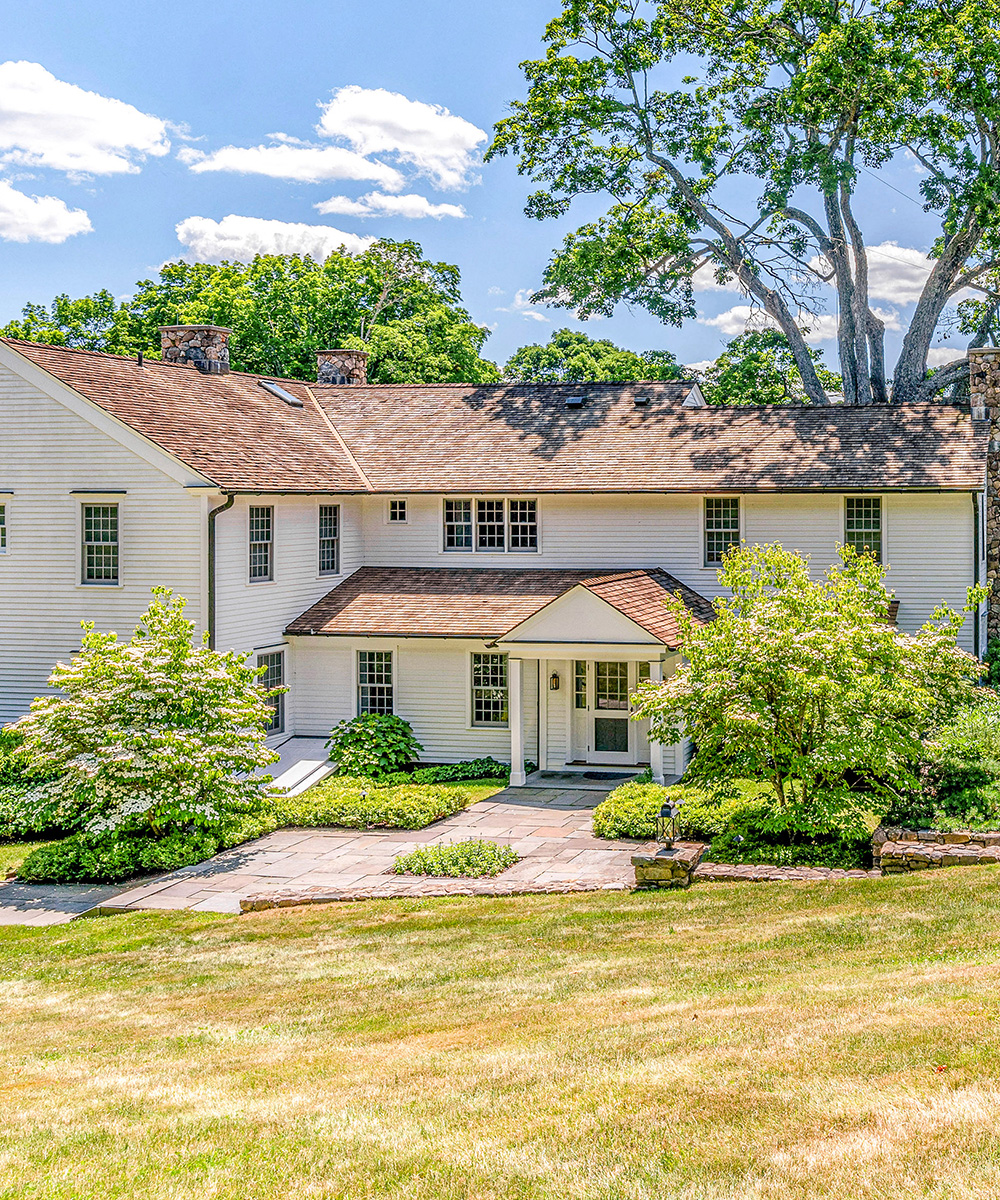
The Marsh-Whitlock House, built in 1738 in Warren, is Litchfield County’s oldest continuously occupied historic home.

By Jack Sheedy
Photograph Courtesy of Warren Historical Society

Discounting the Thomas Painter House (c. 1686) that was moved from New Haven to Litchfield in 1959, Warren’s Marsh-Whitlock House (1738) claims the distinction of being the oldest continuously occupied house built in Litchfield County.

An allotment on what is now Brick School Road was sold by Elisha Williams to Ebenezer Marsh early in 1738, after which Marsh built a post-medieval saltbox with a steeply pitched, side-gabled roof, says Heather Forstmann, curator/town historian of the Warren Historical Society. It likely was originally unpainted. A large central stone chimney is still a prominent feature.

The next long-term tenant/owner was Samuel Whitlock in 1754, Forstmann says. “Whitlock’s family retained ownership well into the 19th century.”

Whitlock probably updated the oven and hearth, according to a report by Fred and May Hill, who owned it in the 1980s. The Hills helped determine it was the oldest house in Warren, and they gave it the name it bears today.

The Hills also passed on a legend that a woman named Granny Carey, who owned the house from 1937 to 1969, would bring her horse, Connie, inside on cold nights so she could warm herself with the mare’s body heat. 

The Marsh-Whitlock House sits on 28-plus acres with a pond, walking paths, and detached barn, according to a 2024 real estate listing. It is currently owned by an entity identified as 1120 Trust, Forstmann says.

Current Issue
March / April 2026
Our Kind of Healthy
The Health & Wellness Issue
Subscribe Now
.
  • STAY IN THE KNOW

    Your weekly guide to can't-miss events, hidden gems, and local favorites in Litchfield County. Sign up now for curated things to do, eat, and explore—delivered every week. It’s free. It’s local. It’s essential.

  • Karen Raines Davis