




January 29, 2026
By Christopher Stella
Photograph by Phil Dutton
During the winter, the face of Bantam Lake becomes an opaque sheet of silvery ice punctuated with spots of color: reds and blues of plastic coolers, neon orange flags, the camouflage coats of bundled anglers.
Ice fishing on Bantam is a seasonal exercise in patience, presence, and community, with families returning to the lake each year to form new friendships, and share food and conversation.
The lake’s location is prime—the climate of the Litchfield Hills provides more reliably “fishable” ice than what’s found in other parts of the state. It is home to an abundance of edible fish, including chain pickerel, yellow and white perch, largemouth bass, and northern pike—a fish native to the upper Midwest and Canada that was introduced to Bantam Lake in 1971.

“Every year we restock Bantam Lake with pike from Minnesota,” says Christopher McDowell, a fisheries biologist with the Connecticut Department of Energy and Environmental Protection’s Warm Water Program (and himself an angler). “It’s a predator that keeps smaller fish from overpopulating. They’re also active during winter, which makes them a great target for ice fishing.”
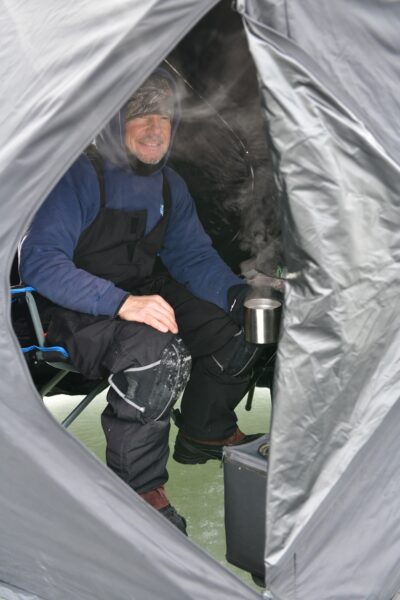
The sport requires patience, dedication, and proper equipment. Because the lake can only be accessed via public boat launches, and motorized vehicles are not allowed on the ice, everything must be hauled in by hand. Anglers load their sleds with a bar or auger to drill through the ice, skimmers to clear the holes, bait, jigging rods, small shelters for windy days, and tip-ups—devices that hold a line and erect a neon flag when a fish is caught, allowing multiple lines to be fished at once. Safety is essential, with ice picks, a throwable rope, a whistle to signal emergency, and flotation devices required for all participants—including pets. Dressing for the occasion requires layered wool and windproof outerwear (cotton should be avoided because it holds moisture), insulated waterproof boots, and sunglasses. “You should let people know exactly where you’re going,” notes McDowell. “It’s a safety precaution, as well as an opportunity–ice fishing is a communal event.”

The sport’s stationary nature lends itself to gathering. Once lines are baited, the day often settles into a rhythm of tending flags and sharing food with friends. Portable barbecues are frequent on the ice. When the day concludes, participants clean up food (which can attract animals) and pick up any refuse or extra line that could entangle wildlife. Even on the ice, dog owners must curb their dogs.
 Ice fishing not only creates memories, it supports sustainability. “Serious anglers keep detailed logs about the conditions on the lake and what they catch,” notes McDowell. “The information they provide helps us understand where we may need to allocate more resources.” For novices interested in trying the sport the Connecticut Aquatic Resources Education (CARE) program offers informational videos and online courses. But the best way to get started is to visit Bantam Lake on a clear, cold day and speak to the anglers themselves. “They’re eager to share information,” notes McDowell. “Lasting friendships are made when you’re on the ice talking, eating, enjoying nature. Sometimes, you forget you’re fishing.”
—portal.ct.gov/deep/fishing/general-information/ice-fishing