October 25, 2026
By Alexandra Mazza
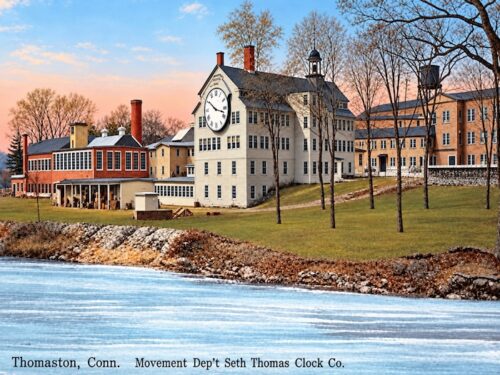
Image courtesy of the Thomaston Historical Society
When the clocks fall back this November, spare a thought for Thomaston, the town whose name is synonymous with American timekeeping.
Long before it became Thomaston, the area was known as Plymouth Hollow. It was first explored in 1657 by a Farmington hunting party that found what it thought was a lead mine at a spot called Lead Mine Brook, though no fortune came of it. Henry Cook settled the region around 1727, and by the late 1730s, 14 families called it home. In 1739, they split from Watertown and Waterbury to form Northbury Parish.
The town’s true turning point arrived with clockmaker Eli Terry, who pioneered the mass-production of clocks in the early 1800s. In 1813, fellow clockmaker Seth Thomas bought a mill in Plymouth Hollow and established the Seth Thomas Clock Company. The business expanded steadily until the town incorporated in his honor in 1875 as Thomaston (literally, Thomas Town).
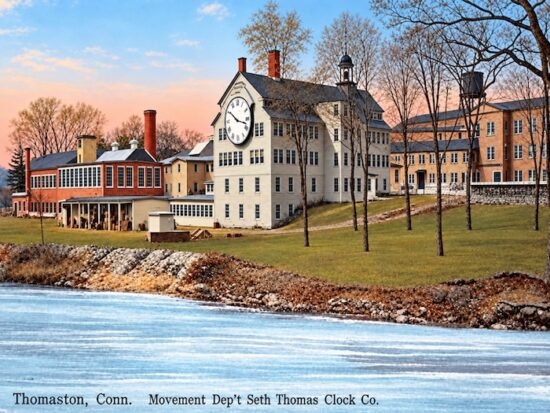
Into the 20th century, the Thomaston Knife Company, Plume & Atwood, and the Hallden Machine Company joined the Seth Thomas Clock Company as downtown’s industrial backbone, anchored by the 1884 Town Hall, Opera House, and the Morse Block.
Today, the old clock factory hums on as an industrial park, the Naugatuck River winds past preserved brick buildings, and the town, which marked its 150th anniversary in 2025, keeps ticking along—fitting for a place that was keeping perfect time a full century before daylight saving even existed.